
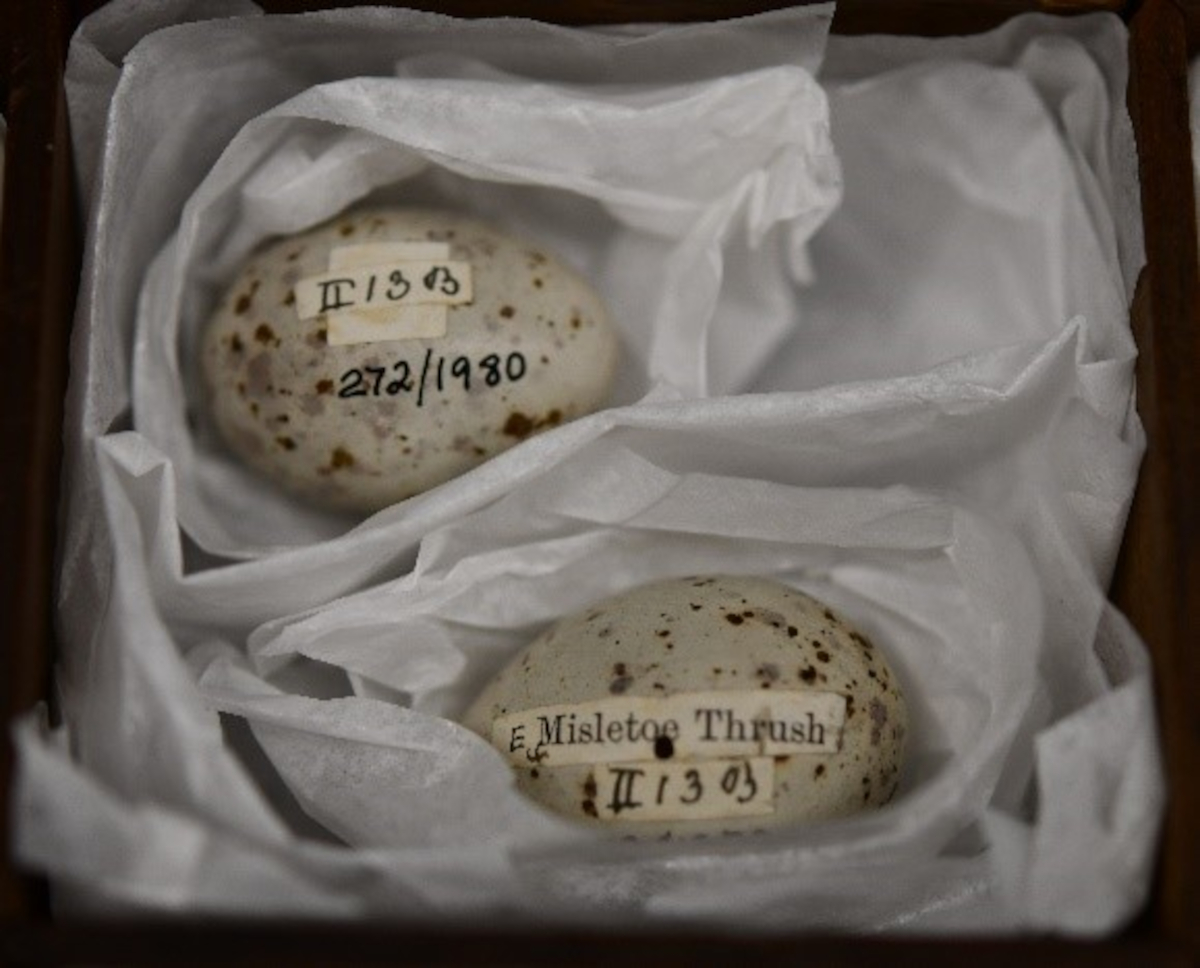
Eggs with original labels. Image courtesy of Victoria Young
Every object in a museum has its own record on a collections management system (CMS) and it is good practice to update records, whenever we have new information to add. Lily recorded the numbers, identification and condition of the eggs. She recorded a total of 129 eggs and one ‘fragment’, noting how many eggs were cracked and how many were complete. This information is important, allowing comparison with previous condition assessments, to see if the collection is deteriorating in any way.
A personal touch
With the additional information provided by the handwritten notebook found in the drawer and a very large amount of curiosity, Lily and I set out to find out more about the donor and collector to also add to the computer record. With the help of two of our other collections volunteers, Jane D and Jane O, we have been able to uncover some information about the collector. Jane D delved into the history whilst Jane O was able to give some context and a personal touch to this donation.
The collection was donated by a Miss Lauris Greener, who was related by marriage to Jane O. Jane herself is very familiar with the area where they lived and where the actual eggs were collected from by Lauris’ father, Arthur Greener. It is a lovely coincidence that Jane has spent many years now looking after them in our stores.
Collected as a teenager
Lauris was born in 1903 and had two sisters. She trained to become a children’s nurse, and qualified as a Norland Nanny. She lived with her mother, Ada Mary, in Wylde Green in Sutton Coldfield, and later in Henley–in-Arden where she lived until her death in 1995. As stated previously the eggs had been collected by Lauris’s father, Arthur Wellington Greener, born 1872 in Erdington. Initially it was assumed that he had collected them as an adult, but Jane’s research showed that the eggs he had collected and recorded in his notebook were collected by him as a teenager. As can be seen, ‘Marsh Tit’ eggs were collected in 1889.

A section from the notebook detailing where the eggs of the Marsh Tit had been taken. Image courtesy of Victoria Young.
Arthur recorded exactly where the eggs had been taken from. From these locations, Jane, looked at the census and old Ordinance Survey maps and was able and get an idea of the area Arthur was visiting as a child. The area also reflects the social standing of the Greener family.
The 1871,1881 and 1891 census records the family as living at The Cedars, Grange Road , Erdington. It was from here that he collected six ‘Pied Wagtail’ eggs in 1889.

Part of the notebook referencing the Cedars. Image courtesy of Victoria Young.
Grange Lane and New Hall are areas which appear in the notebook. The Grange was a large house opposite their own home and New Hall is close by. It was an old moated medieval manor house, now a luxury hotel.
An attitude we may not share today
These recordings also reflect Arthur’s attitude to collecting eggs, one which we may not share today. At the Warren New Hall, Arthur took four ‘Lapwing’ eggs, while the mother was sitting on the nest in the potato field. The pheasant’s eggs he collected at Riley Wood New Hall were ‘Nearly hatched when taken’.
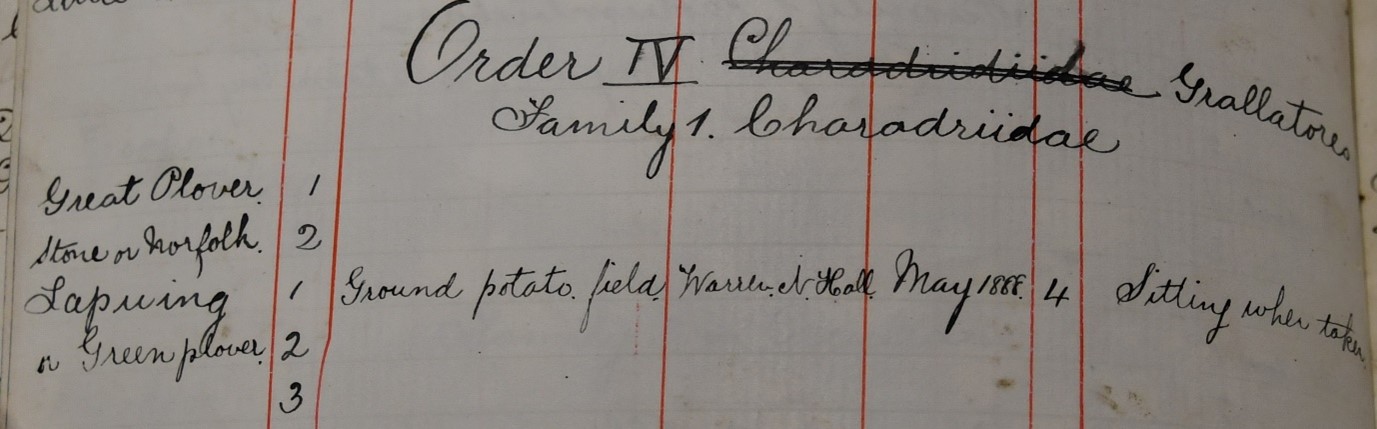
Part of the notebook detailing Arthur’s collection of Lapwing eggs. Image courtesy of Victoria Young.
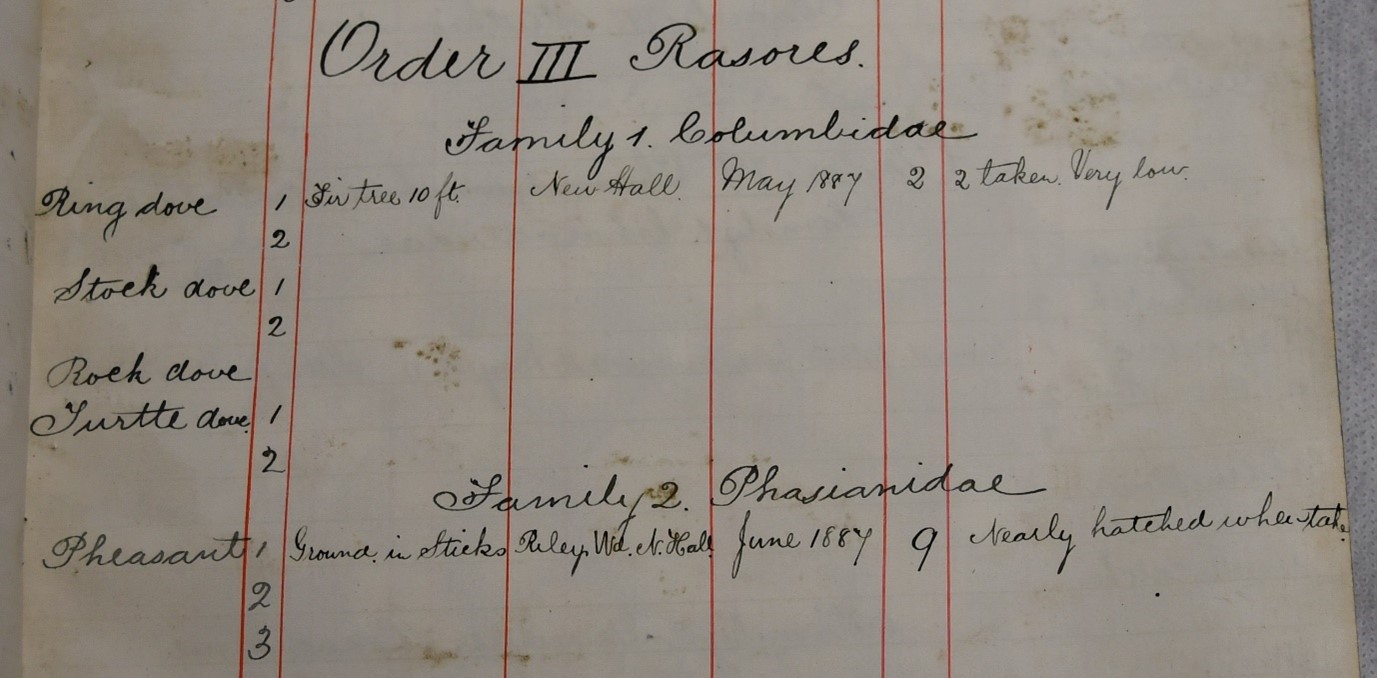
Part of the notebook detailing Arthur’s collection of the pheasant’s eggs. Image courtesy of Victoria Young.
Arthur appears to have been able to spend some of his early years roaming the countryside before he followed in his father’s and grandfather’s footsteps as a gun maker. The Greener family were well known in different parts of the British Empire during the 19th century for their development of the ‘Empire’ gun, designed in a way that it never needed to be returned to Britain for repairs.
An amazing job
Working with our collections at the museum is an amazing job. You never know what you are going to be required to do or discover. This small part of the egg collection project has proved just how much there is still to learn about our natural history collection, the human stories behind the objects themselves, and the value of having such patient, dedicated and knowledgeable volunteers as Lily and the two Janes, eager to help us pursue these stories.
These blogs have been written with much help and support from Jon Radley (Curator of Natural Sciences) and volunteers Lily Liu, Jane Dennick and Jane O’Dell





Comments
Add a comment about this page