

It is a widely held belief that Ridley Scott’s 2023 epic film Napoleon, featuring Joaquin Phoenix, was something of a failure. Boiling down the career and passions of one of history’s most complex characters into a mere 157 minutes was always going to be an ambitious task. His petulant love affairs with Josephine were transformed into pantomime, his revolutionary reforms were brushed over with only the blood strewn battles treated in any serious way. This is not to mention Apple Studios and Scott Free Productions’ choice to set the entire film against a backdrop of English country houses, showing France’s golden generation eating in English dining rooms filled with British portraits and furniture. CGI and computers can only go so far, with one example being the lifeless transformation of the courtyard of Blenheim Palace into Moscow’s ancient Kremlin.
Alive in the Warwick Castle Archive
In my view, the spirit of Napoleon Bonaparte is more alive in the Warwick Castle Archive held at the County Record Office than in Ridley Scott’s $137m epic. The effect of this single man on Warwick Castle and the family of the Earls of Warwick was vast. This is perhaps to be expected of a figure who embodied the French Revolution and progress in the face of established order in Europe.
The Earls of Warwick and Warwick Castle had participated in Anglo French hostilities for centuries. It seems obvious that the descendants of the medieval warriors of the Hundred Years War would relish in the opportunity to face down England’s old enemy once more.
A threat to traditional ways of life
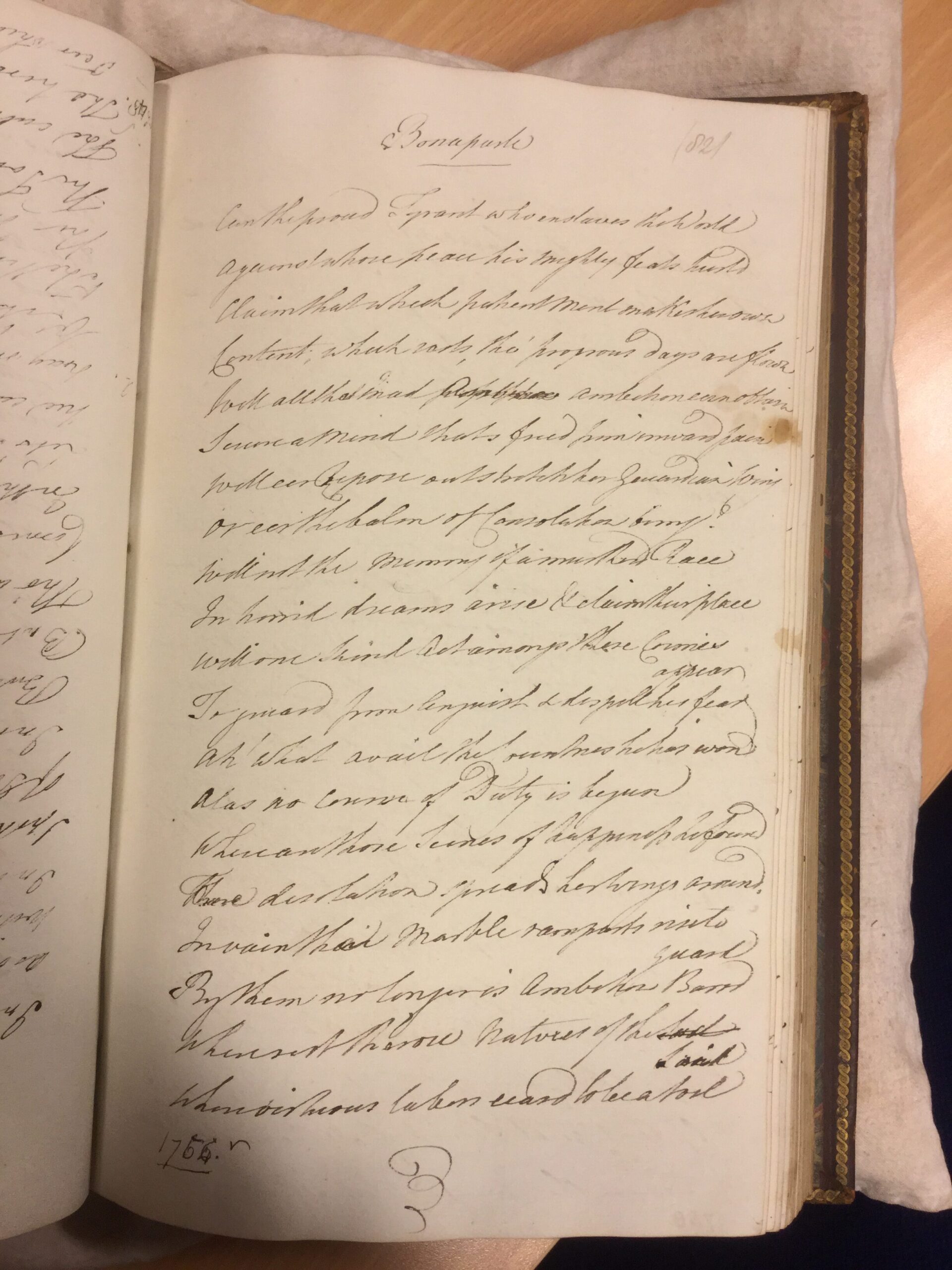
There is ample evidence in the papers to show that George Greville (1746-1816), 2nd Earl of Warwick, the patriarch of the Warwick and Greville family during the Napoleonic wars, thought and felt deeply about Napoleon’s existential threat to traditional ways of life. His poetry manuscript in the archive, a neglected document that provides a window into his mind, shows that he scratched at least two poems and verses in ink dedicated to France’s supreme leader. The first, entitled Bonaparte, foreshadows Leo Tolstoy’s vision of the Corsican upstart as a slave of history, his tyranny creating new chains which will only lead to misery and suffering. In his second poem The Eagle (inspired by Napoleon’s Imperial eagles), George imagines the tyrannical spirit of Revolutionary France as a bird of prey, circling the fair coast of England protected only by the ancient bow of a Shepherd. In my opinion, these poems are more evocative of the earth-shattering effects of Napoleon’s influence than in any section of Ridley Scott’s film.
As the Lord Lieutenant of Warwickshire during the crucial years 1795 until 1816, George’s young sons participated in interesting encounters in Europe and beyond during the Revolutionary and Napoleonic wars. His son and heir Henry Richard Greville (1779-1853), Lord Brooke and later 3rd Earl of Warwick, had taken the opportunity to travel around the continent (but avoiding France) during the brief peace following the Treaty of Lunéville and Treaty of Amiens in 1801 and 1802. His Grand Tour memoir, also in the archival papers, recounts the devastation he encountered in Switzerland and Italy after Napoleon’s conquests there. He particularly bemoaned the loss of Italy’s treasures to the Louvre in Paris, and recounted the fresh French musket shot that disfigured Leonardo da Vinci’s fresco of The Last Supper which he saw in Milan. He made it all the way to Constantinople until Britain’s intentions to declare war on France curtailed his travels.
Fearing doom
It was during his way home through Bucharest, Romania, that the young Henry would learn of the oncoming storms. Whilst dining with the Prince of Moldavia he recounted ‘The dinner not very good, but the music far from bad. They struck up God Save the King – which we were pleased with when we considered the State of Europe at the time – & we were the nation to be devoted to Bonaparte’s vengeance.’ A few days later whilst conversing with some Austrian officers he was told ‘that England was to be sword to distinction & invaded. Bonaparte was marching again to subjugate Europe but we were to be first sacrificed – I should never let him & if I did – England was to be punished, & London burnt. He shook me cordially by the hand & wished me every success – but feared our doom.’ This was not the end of the Grevilles’ interactions with Napoleon however.





Comments
Add a comment about this page