
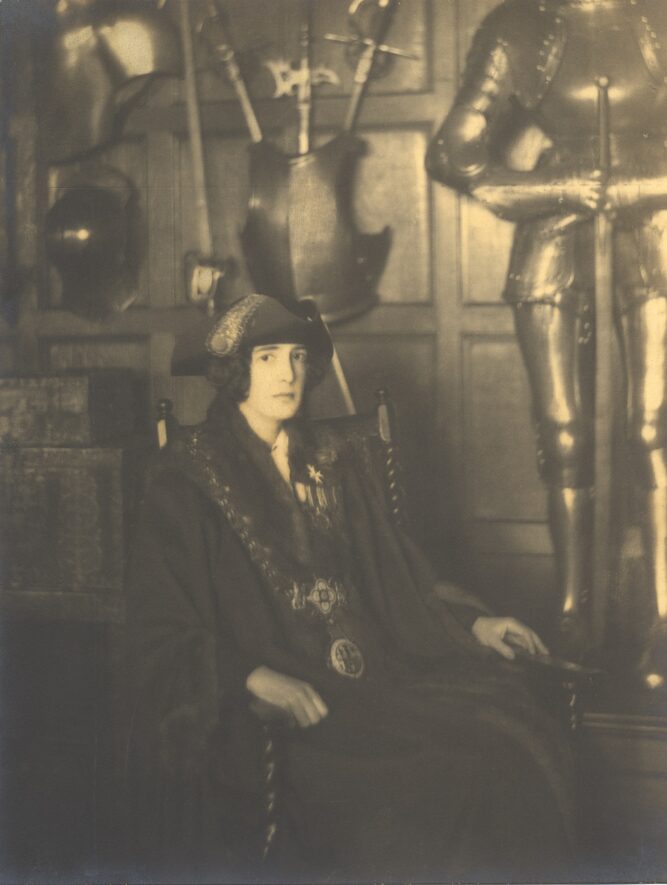
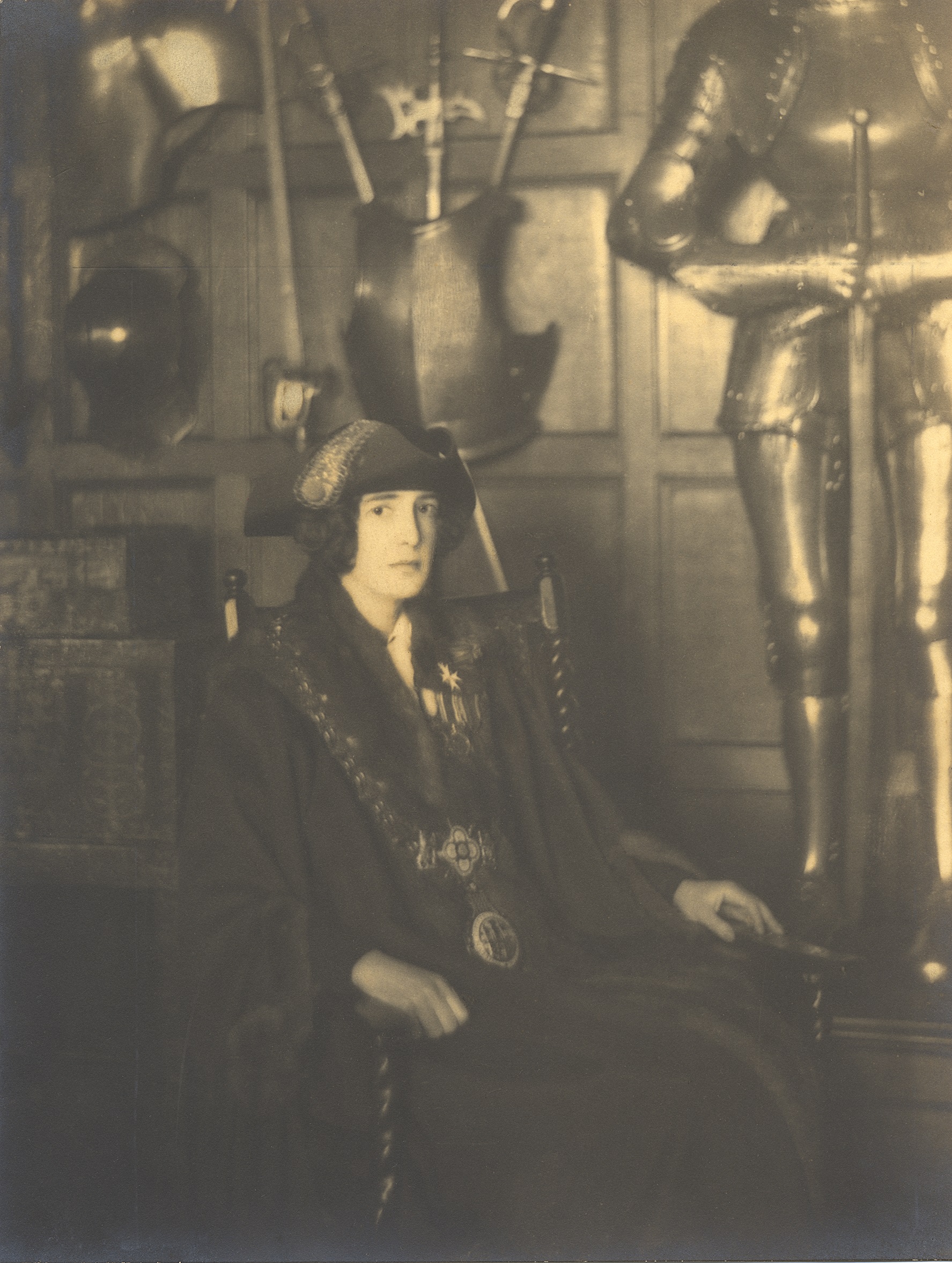
The relationship between Marjorie, 6th Countess of Warwick, and her son Charles Guy ‘Fulke’ Greville, 7th Earl of Warwick, became an increasingly uneasy one over the years. Correspondence in the collection provides us with hints and clues that allows us to map this decline.
Perhaps there was a certain inevitability of troubled waters ahead, emerging from Marjorie’s difficult marriage to Fulke’s father Guy, an alcoholic from whom she finally separated in around 1920, following on from some unspecified cataclysmic event.
A nomadic existence
For a while she and her three sons appear to have led quite a peripatetic existence, while she looked for a new home1 and during this time the children stayed with relations, seemingly away from her.
From boarding schools in England, Marjorie’s sons were sent to Chillon, a school in Switzerland. And while the relationship between Marjorie and Fulke had probably begun its downward trajectory beforehand, Chillon may have helped speed things along.
Challenging behaviour
Several letters indicate Fulke was exhibiting challenging behaviour2. Marjorie’s words mostly don’t exist in the collection to reveal Fulke’s troubles, but we see advice and opinions offered by friends, relatives and teachers concerning displays of unacceptable behaviour3. It would seem all believed Fulke could do well, if only he would apply himself.
At the end of 1927, Fulke had learned how dangerously ill his father was and he wrote to his mother requesting that she allow him to return home to help her4. We know this request was denied as he didn’t return before his father’s death early the following year. He made further requests to return after his father’s death, but again it seems he was kept at school.
After finishing his schooling, Fulke attended Sandhurst. In a letter of February 1929, he affirms to his mother that he will go to Sandhurst, but it is against his own wishes, and he insists he will not stay in the army for long5. He is true to his word, joining in 1930 and leaving in 1932.
Matters become strained
Matters became strained to such an extent that in 1932, Marjorie was compelled to write to her son to be mindful of improving his reputation and not to write to her again until he could be respectful to her6.
She was clearly dismayed at his conduct and perhaps denial of responsibility, but did she also fear he was following in his father and both grandmothers’ (‘Daisy’ Greville and Sybil Eden) dissolute footsteps? Daisy certainly didn’t help matters. We see that when Marjorie attempted to dissuade Fulke from spending money on a Rolls Royce in May 1932, Daisy championed him to buy it explicitly against his mother’s wishes, deeming it as his birthright7.
A distant parent
Perhaps the most damning evidence as to how Fulke felt towards his mother comes to us in a letter from her to him in 1938, In which she pleads that her grandson, David, be allowed to come to see her at her flat8. We don’t know how, or if Fulke replied.
Marjorie might today appear to be a rather disapproving and perhaps distant parent. It is clear she herself felt the responsibility of her position and believed in duty. After all, she had worked on an ambulance train during WW1, and served as both a magistrate and Mayor for Warwick Borough, and she probably wanted her son to prove himself. She might also have feared Fulke’s fate would mirror his father’s, without a firm hand to guide him.
A difficult childhood
Fulke had experienced a difficult childhood, and it must be said, adulthood. He attempted to become a Hollywood actor, married three times, handed over his Warwick estate to his son, David, who he then witnessed sell it. He would eventually live as a tax exile, dying in Italy.
But maybe we can look at Marjorie’s highhandedness and Fulke’s irresponsibility and sympathise with both mother and son. And beyond all the evidence of a difficult relationship, there are other letters expressing affection between the pair, although clearly there were bridges broken that were probably never mended by the time of her death in 1943.
References
1 According to a letter she received from her brother Tim – Jul 1920, Warwickshire County Record Office reference CR1886/737/5/11.
2 One from Fulke, himself, Warwickshire County Record Office reference CR1886/1078/1/78, May 1927.
3 Dec 1925, Warwickshire County Record Office references CR1886/1078/1/308; 1926-1927, CR1886/1079/2/24-36.
4 Dec 1927, Warwickshire County Record Office reference CR1886/1078/1/101.
5 Warwickshire County Record Office reference CR1886/1078/1/135.
6 Apr 1932, Warwickshire County Record Office reference CR1886/645/5/4.
7 Warwickshire County Record Office reference CR1886/1075/5/34.
8 Nov 1938, Warwickshire County Record Office reference CR1886/1075/4/3. She also writes about it to the estate land agent, Hollyoake, 1930s, CR1886/1078/1/352.





Comments
Add a comment about this page