
Sweet Lady, can your weeping eye behold
A paper, sadly offer’d, where ‘tis told
Your Lord is Dead? And so untimely too?
Treble to you, us a double woe.
Tis sad to say; sadder to you to heare:
Unhappy he, must be the messenger.
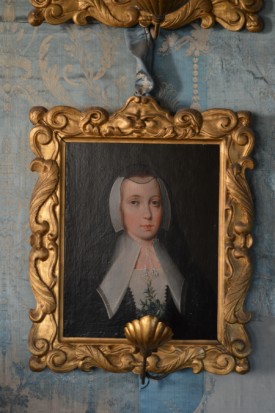
This is part of an elegy written to Katherine Greville, Lady Brooke in 1643 by John Wallis, Mathematician and the Chief Cryptographer to the Parliamentarian cause. Katherine was widowed at 25 with four young sons and pregnant with the fifth; an uncertain future with the country divided by civil war.
She was born Lady Katherine Russell, daughter of the 4th Earl of Bedford. He was a capable man by all accounts, apparently responsible for draining the Fens and promoting the building of Covent Garden Square; a leading Parliamentarian who opposed James I and Charles I on a number of issues and crucially a puritan. He died of smallpox in 1641 but by then he had married off Katherine to Robert Greville, the adopted heir of Fulke Greville. Robert was a controversial figure and was not universally accepted by the established aristocracy, having come from relatively humble beginnings. He was however a committed Parliamentarian and a rising star in the early phase of the civil wars.
Robert Greville’s death
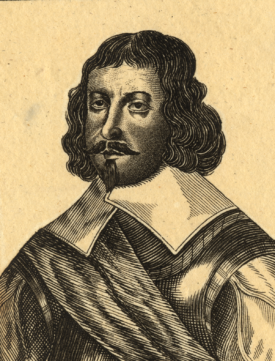
Robert was appointed Captain of the Warwickshire and Staffordshire regiment that saw action at the Battle of Edgehill (without him it seems). He was at the Battles of Southam, Brentford and Stratford upon Avon before disaster struck at Lichfield. Whilst overseeing a siege of Royalist forces Robert was improbably killed by a sniper’s gun (likely from a large weapon known as a fowling piece or duck gun) shot from the tower of Lichfield Cathedral.
Katherine was now in a vulnerable position and her circumstances took a worse turn the following year in 1644 when the King granted wardship of her eldest child, Francis, to the Royalist George, Lord Digby. This was an ignominy for Katherine made worse by the fact that Digby was married to her sister. The right of wardship and livery meant that the crown took on responsibility for young orphaned heirs under the age of 21 where their father’s estate had come from the Crown i.e. Warwick Castle. The Crown would make arrangements for the care and marriage of the young heirs and would have rights to the income generated by the estate until the heir reached adulthood. Sometimes the wardship would be given to individuals as a reward for services, which may be the case here.
Wardship
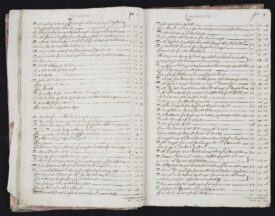
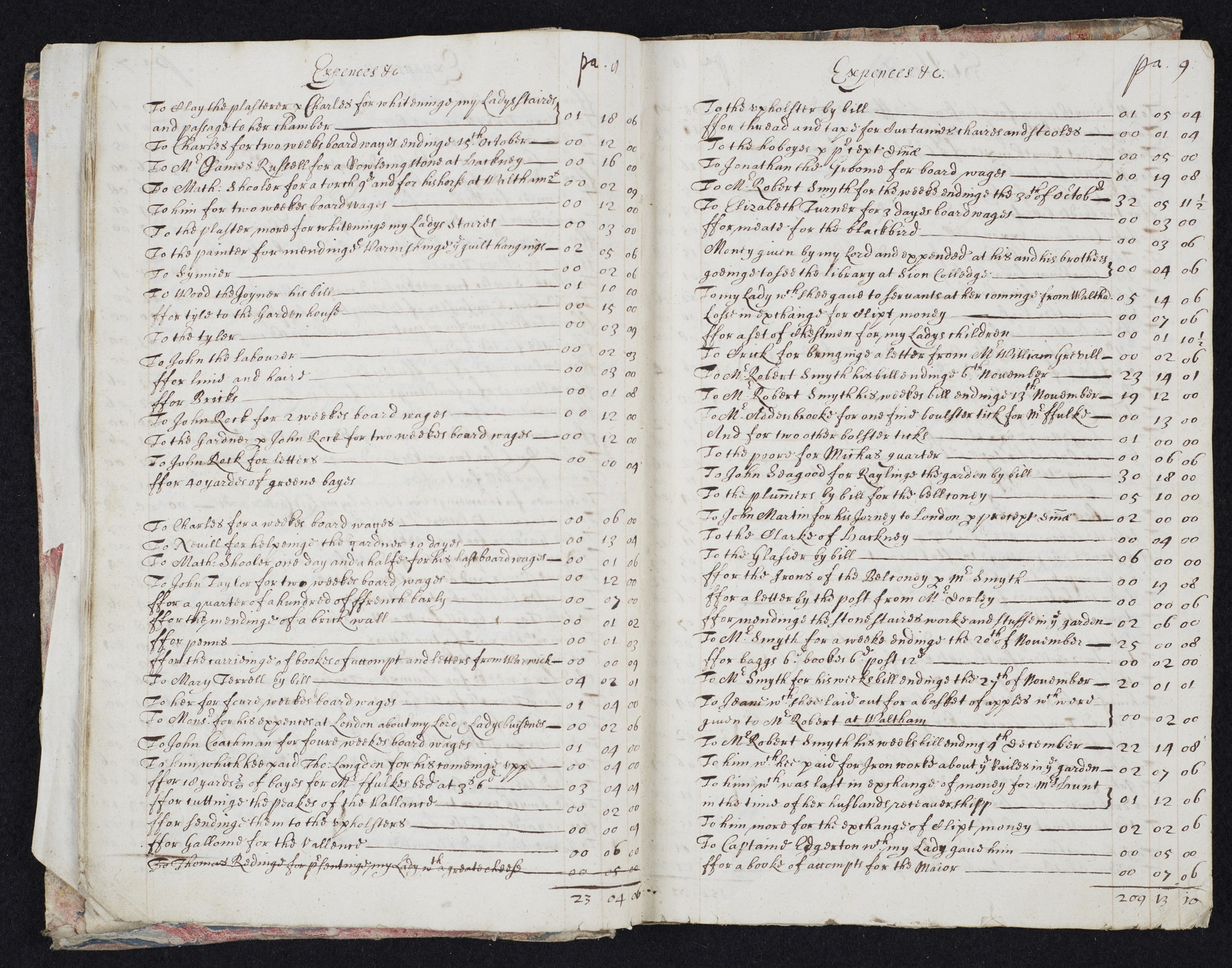
The Warwick Castle archive contains the royal command for the wardship of Francis, issued on 15 April 16441. Additionally, the collection includes a fine series of household accounts, that mention Katherine frequently, including evidence of the legal case that ensued following the ward of court. She fought the decision successfully, petitioning Parliament to overturn it and secured a £5,000 maintenance fee for Francis in 1648. She has been described as probably the most richly rewarded widow of the Civil Wars.
As well as sorting out the wardship issue she was also required to negotiate the resolution of the debts her husband had incurred during investments in puritan colonial adventures with the Providence Island Company. The accounts show her diligence in providing clothing, education, pets and trips. One particularly unusual trip with Francis was to the trial of the Duke of Hamilton and the Earl of Holland in 16492. The pair were tried for their support of the Royalist cause in separate actions during the second English Civil War and were subsequently executed. This might be a surprising treat for a child by modern standards certainly, but it perhaps reveals that Katherine’s support of the Parliamentarian cause ran deeper than an obedience to the political leanings of her father and husband.
Not kept to herself
Katherine wouldn’t have kept the accounts herself, they would have been written by senior household staff, but she features frequently and her signature in approving them is conspicuous. She is believed to have spent the years immediately following Robert’s death in the Greville Households in London, returning to oversee repairs to the castle and garden in 1652 following its use as a prison, hospital and as a fortification during the ravages of the conflict. Katherine was successful in leaving a solid legacy for her son to inherit and died in 1676 in her late 50s; sadly only one of her sons was still alive and that was the youngest, Fulke, who she was carrying when her husband was assassinated.
1 Warwickshire County Record Office reference CR1886/BL4663
2 Much of the information in this article is drawn from the excellent volume produced by the Camden Society: The Household Accounts of Robert and Katherine Greville, Lord and Lady Brooke, 1640-1649 by Beale, Hopper and Hughes, which allows us to see the full extent to which Katherine was involved in managing the estate and the care of her sons.
Civil War Tracts, B.M.Thomason Collection, British Library E93(21)
The World Turned Upside Down podcast – A Family at War – Lord and Lady Brooke of Warwick (2025)
The Household Accounts of Robert and Katherine Greville, Lord and Lady Brooke, at Holborn and Warwick, 1640-1649, Camden 5th Series. Ed. Stewart Beale, Andrew Hopper and Ann Hughes (2024)
Wikipedia, Francis 4th Earl of Bedford
Wikipedia, John Wallis
The National Archives: Courts of Wards and Liveries
BCW Project





Comments
Add a comment about this page