
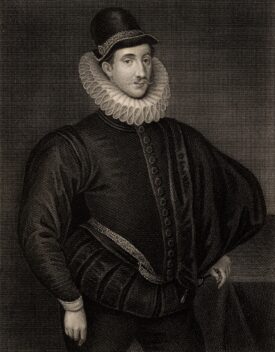
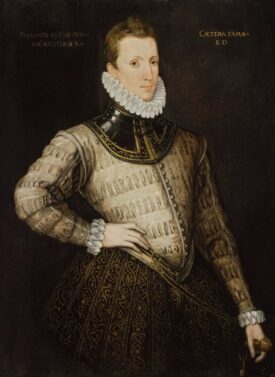
Let all that is sweet is, void; in me no mirth may dwell:
Philip, the cause of all this woe, my life’s content, farewell
This is an from elegy to Sir Philip Sidney written by his friend and biographer Sir Fulke Greville. Sidney died as a young man of 31. The death of his friend was a major event in Greville’s life and the effect was felt by him until his own violent passing at the age of 74.
Both men were courtiers, poets and would-be soldiers in the Elizabethan court. Sidney was well connected – his father was Lord President of the Marches of Wales and he was nephew to Robert Dudley, Earl of Leicester; he dazzled at court, a charismatic presence. Greville was more sober, the son of a knight and Warwickshire landowner1. He was intelligent, capable and ambitious and went on to achieve high office2.
Met at the age of 10
They met at Shrewsbury school in 1564 at the age of 10. The school register records that they started on the same day, 16th November, and were both placed in class three. A surviving school book of Sidney’s contains the graffiti ‘Foulke grivell is a good boy’, though we don’t know which one of them wrote this.
After school Greville studied at Cambridge and Sidney at Oxford, though a connection remained between them. Greville worked for Sidney’s father in the Welsh Marches and then joined Sidney at Court.
As young noblemen of the time, both harboured ambitions for travel and military adventure. In his biography of Sidney, Greville recounts the story where the two of them steal away from Court to join Francis Drake in Plymouth, with the intention of joining him on an expedition to the West Indies. Drake’s discomfort is noticeable and aware of the Queen’s likely displeasure, he sends a message alerting Elizabeth. The adventure is foiled, much to Sidney’s displeasure.
Besotted with Sidney
In truth by then they were both in their 30s and had experienced travel to Europe. Sidney was sent on a two year trip to improve his knowledge of language in 1572. Staying in Paris, he narrowly avoided the Great Massacre of Hugenots at St.Bartholomew. He travelled down the Rhine to Frankfurt and encountered the learned Protestant scholar Hubert Languet; though an older man in his 50s the two become great friends. Languet is believed to have been the inspiration of one of the characters featured in Sidney’s great literary work Arcadia. There has been some speculation that they may have been more than friends – Languet wrote many letters and poems to Sidney after they parted and, Sidney (though less frequently) responded. Languet certainly appears to be besotted with Sidney from the tone of the correspondence, and in that he is not alone.
In 1577 Greville accompanied Sidney on a diplomatic mission to the Low Countries and Germany where he met Languet, and was later required to accompany the Frenchman home after a visit to England. Languet later wrote to Sidney commenting on Greville’s admiration and great love for Sidney. Their close bond would continue.
References
1 Beauchamp Court near Alcester.
2 Treasurer of the Navy (1598) following the second and third attempted Spanish Armadas, and later Chancellor of the Exchequer (1614).





Comments
Add a comment about this page