
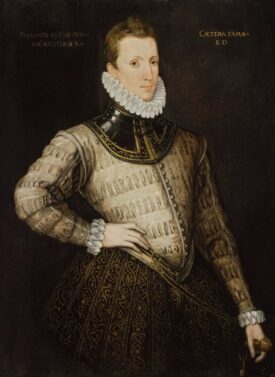
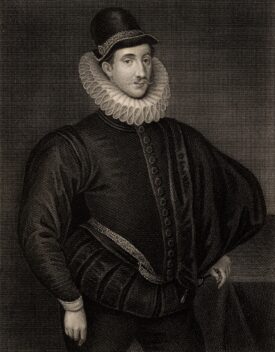
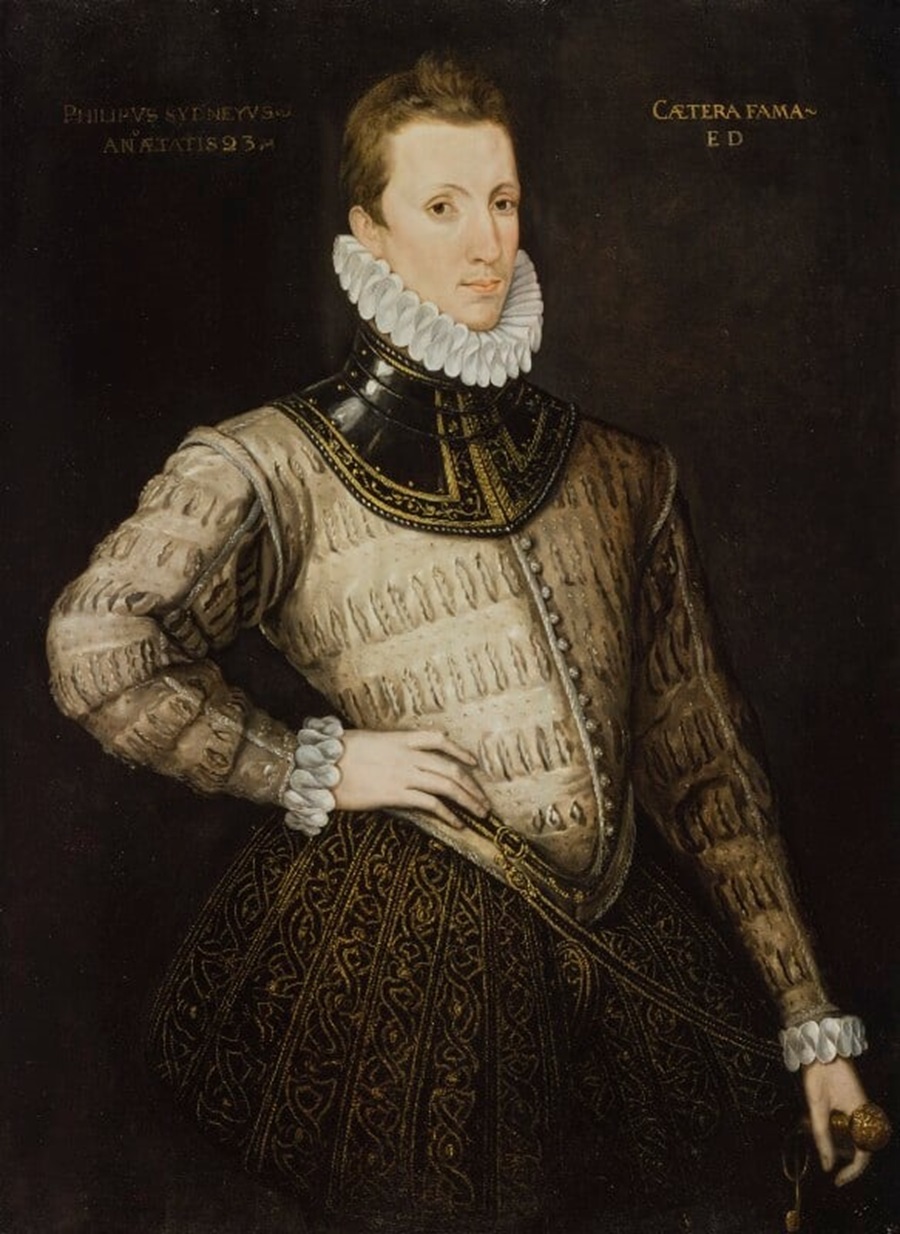
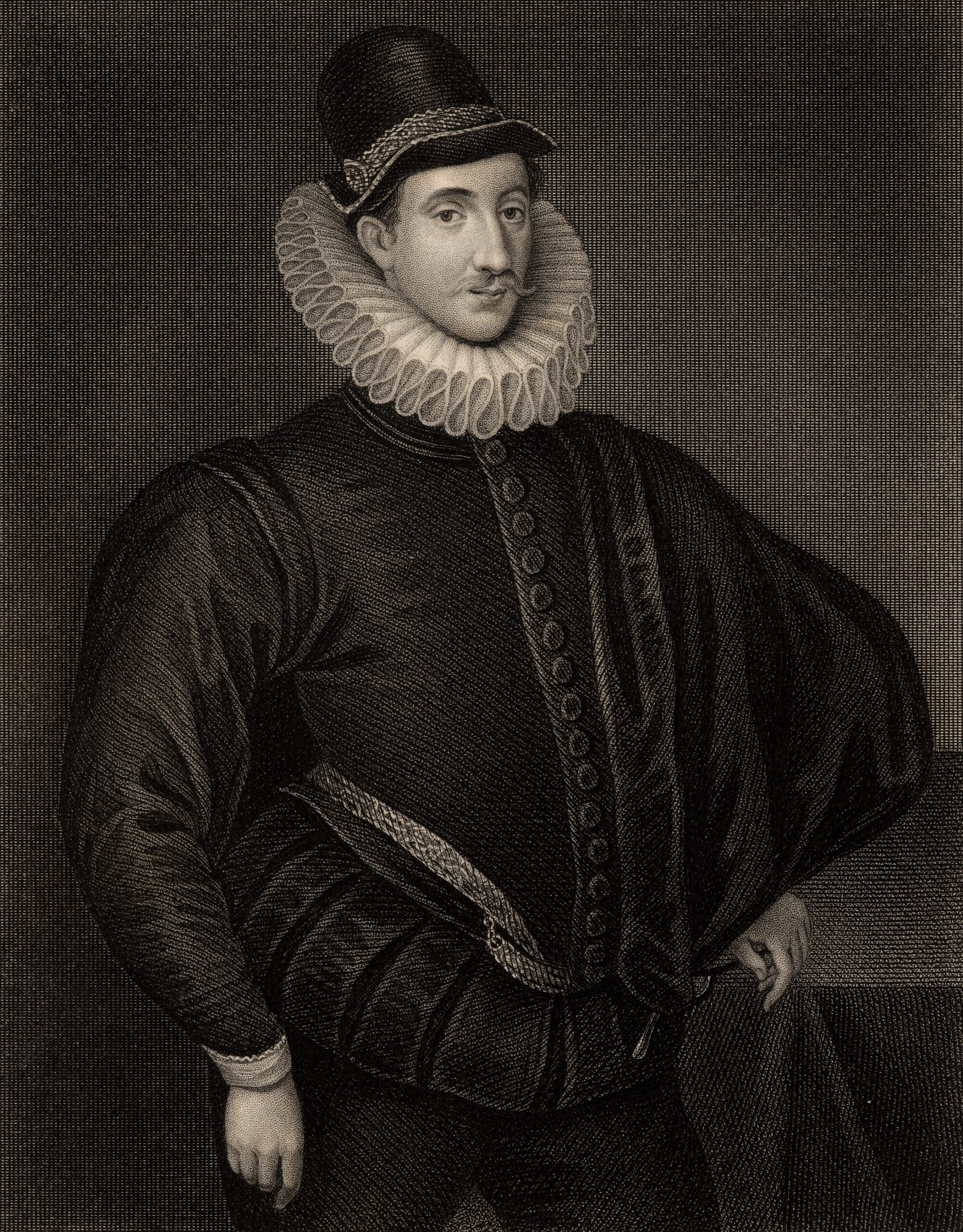
As we have seen, Fulke Greville and Philip Sidney shared a close bond.
Another friend to both Sydney and Greville was the poet, courtier and (alleged) alchemist Sir Edward Dyer. He fell under the patronage of Robert Dudley so there was a mutual connection with Sidney. Older than Sidney by 11 years, he displaced Languet as his main mentor. Sidney, Greville and Dyer formed a close bond with a mutual interest in literary pursuits. The extent of the affection that Sidney felt for them is reflected in his poem ‘Disprayse of a Courtly Life’ :
Only for my two love’s sake, Sir Ed.D. and M.F.G
In whose love I pleasure take,
Only two do me delight
With their ever-pleasing sight.
Never married
Neither Greville nor Dyer married, which was quite unusual for a gentleman of the court at that time. Sidney did however take a wife eventually – namely Frances, daughter of the famous spymaster Francis Walsingham. The Queen initially disapproved of the match for reasons that are unknown. Walsingham was another older man that formed a close bond with Sidney (in this case a fatherly one). There are over 30 surviving letters written by Sidney to Walsingham, and only one mentions Frances. Moreover, in Greville’s biography of Sidney she isn’t mentioned at all. The aborted adventure to the West Indies with Greville was only about a year after Sidney’s marriage. Frances of course was not part of the plans and later, when Sidney was in the Low Countries and Walsingham suggested that Frances joined him, Sidney dismissed the idea.
In 1586 Sydney joined his Uncle Robert Dudley in the campaign to support the Dutch Protestants against the Spanish. During a skirmish at Zutphen, Sidney was shot in the thigh; the wound became infected and he died a few weeks later. There is some correspondence from Dudley that suggests that Frances may have been able to visit Sidney and she miscarried their second child shortly afterwards.
A funeral on a lavish scale
Sidney’s funeral was on a lavish scale – a hero’s return, the largest seen in London for a non-royal at the time. Greville and Dyer were amongst the pall bearers but there was to be no money left for an impressive tomb in St.Paul’s, instead Sidney had to make do with a modest wooden tablet, lost to the Great Fire many years later. Sidney left his library to Greville and Dyer… and his debts to Walsingham.
Greville’s ambitions to honour his great friend went beyond a biography.1 In 1615 he wrote to his agent John Coke, laying out a proposal to install in St.Paul’s a new tomb , more fitting as a memorial to Sidney than the existing wooden tablet. The proposed tomb would be a resting place for both Sidney and Greville. The more prominent position would be reserved for Sidney with Greville beneath, with an epitaph composed by Greville as a testimony to his lasting love and affection. The tomb was never constructed however. Why we do not know, though as Greville advanced in age he spent more time in Warwickshire than in London, and maybe there were other objections.
Greville’s final resting place
In 1628 Greville met his end, despatched by a servant Ralph Haywarde whilst “coming from stool”. Greville’s final resting place is a rather sombre tomb shoe-horned into a side chapel in St Mary’s church Warwick and was prepared around 1625. The most interesting part is the inscription which mentions three people, namely those that he served – Elizabeth his Queen, James his King and of course Sir Philip Sidney, always Sidney.
At various points in his life Greville’s name came up as a possible husband for this or that Lady but none of these rumours seemed to amount to much. He was, like Sidney, more comfortable in the company of other men. Whether he had sexual feelings for Sidney and if these were reciprocated is a matter of opinion; we are looking at the language of the early modern period through the prism of the 21st century. Was Sidney elevated to almost mythical proportions in Greville’s mind over many years or was he just the great love of his life?
References
1 That was not published until after they were both dead.
If an excellent man should err’ Sir Philip Sidney and stoical virtue. Richard James Wood, Manchester Hive
The Life of Fulke Greville. Ronald Rebholz (1971)
Fulke Greville, Lord Brooke, 1554-1628. A Critical Biography. Joan Rees (1971)
Sir Philip Sidney, Courtier Poet. Katherine Duncan-Jones (1991)
Dictionary of National Biography Vol VIII
Dictionary of National Biography Vol XVIII





Comments
Add a comment about this page