
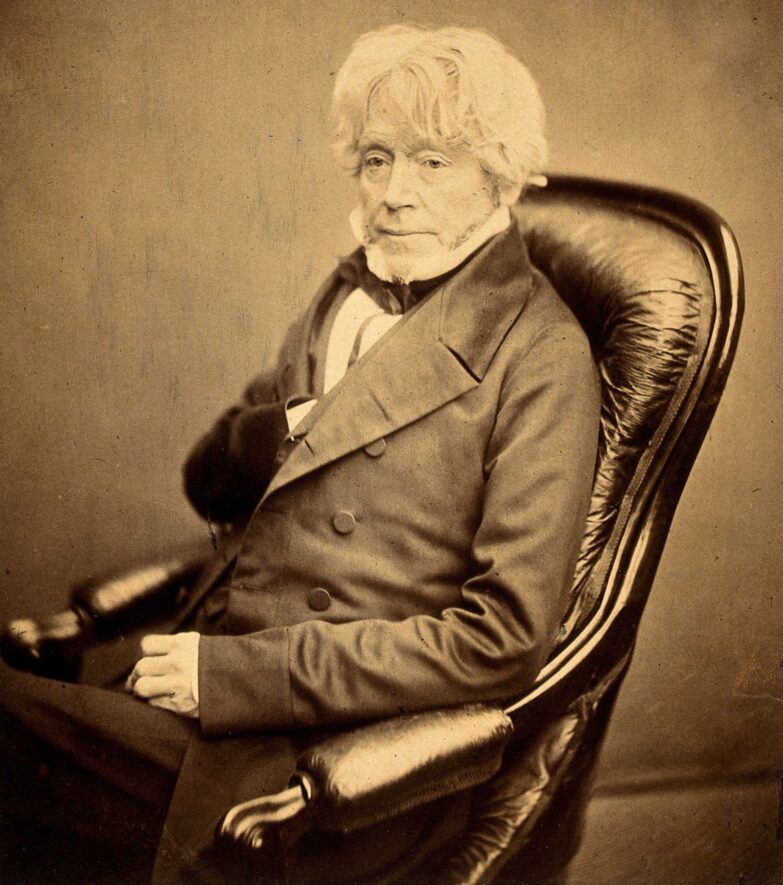
Dr John Conolly was one of the three men who instigated the setting up of the Warwickshire Natural History and Archaeological Society (WNHAS) in 1836, which led to the opening of what is now Market Hall Museum.
Early life and a move to Warwickshire
He was born in Market Rasen in 1794, of Irish descent. His first employment was in the military. He then turned to medicine and graduated with a MD from Edinburgh University in 1821. By 1823, John Conolly was living in Stratford on Avon, where he stayed for five years, until 1828. He became Mayor of Stratford in 1825 and was a keen member of the Shakespeare Society.
After a brief spell in London, he returned to the Midlands and lived in Warwick until 1839. Dr Conolly was a leading doctor in the movement for the setting up of “Self-Supporting Dispensaries.” He became a physician at the Warwick Dispensary in Castle Street in 1832. During the time he was living in Warwick, he was also one of the physicians at the Southam Eye and Ear Infirmary.
Lecturing, publishing, and a founding member
Throughout the 1830s John Conolly lectured on a wide range of subjects at several Mechanics Institution meetings in the Midlands region. In 1832, he delivered a lecture on cholera at the Market Hall in Warwick for the Warwick and Leamington Mechanics Institution. He published several papers taken from his lectures. With John Forbes and Alexander Tweedie, he published Part 1 of The Cyclopaedia of Practical Medicine in 1832. In the same year one of his daughters, Anne Caroline, was born in Warwick and baptised at St Mary’s Church.
John Conolly became one of the founding members of the Warwickshire Natural History and Archaeological Society in 1836, and remained the joint Honorary Secretary until he left Warwick. Whilst he was living in Warwick, he became a magistrate. As a patron or steward, he also supported many fundraising events for the Warwick Dispensary and the Warwickshire Natural History and Archaeological Society.
In 1835, Dr Conolly became the chairman of the committee set up to raise funds for the preservation of the tomb and monument of William Shakespeare in Stratford. In Pigot’s Directory of Warwickshire of the same year, he is listed as a physician living in Theatre Street, Warwick.
Keeping connections to Warwick
In 1839, Conolly moved from Warwick to take up the appointment of Physician in Charge at Middlesex County Asylum at Hanwell. He was a believer in the humane treatment of people suffering from mental illness and introduced ‘moral treatment’ to inmates. He was the first person to introduce this treatment into a large metropolitan asylum and lectured widely on the subject. He remained associated with the Middlesex Asylum until 1852, when he went into private practice and opened his own small asylum in Hanwell. John Conolly was later an advisor to the developers of the Hatton Asylum, which opened near Warwick in 1852.
In collaboration with Sir Charles Hastings and Sir John Forbes, John Conolly began a small medical association with the aim of improving provincial medical practice. This was called the Provincial Medical and Surgical Association, which later became the BMA.
He died in Ealing in 1866.
As part of the Unlocking Collections project, a group of volunteers researched some of the individuals who contributed to the Warwickshire Natural History and Archaeological Society. Research was undertaken at Warwickshire County Record Office.





Comments
Conolly seems to have been a remarkable man, and a pioneer of the (popular at the time) study of phrenology. He was Chairman of the Warwick and Leamington Phrenological Society in the mid 1830s, and apparently the Warwickshire Natural History and Archaeological Society emerged from that group. Conolly had also tried to establish a broader network of midlands natural history societies, as a way of gaining local knowledge of circumstances causing the epidemics of the day. This was only a partial success, but the Warwickshire society went on to great things throughout the nineteenth century, including establishment of the Market Hall Museum in Warwick (1836-present).
Add a comment about this page