
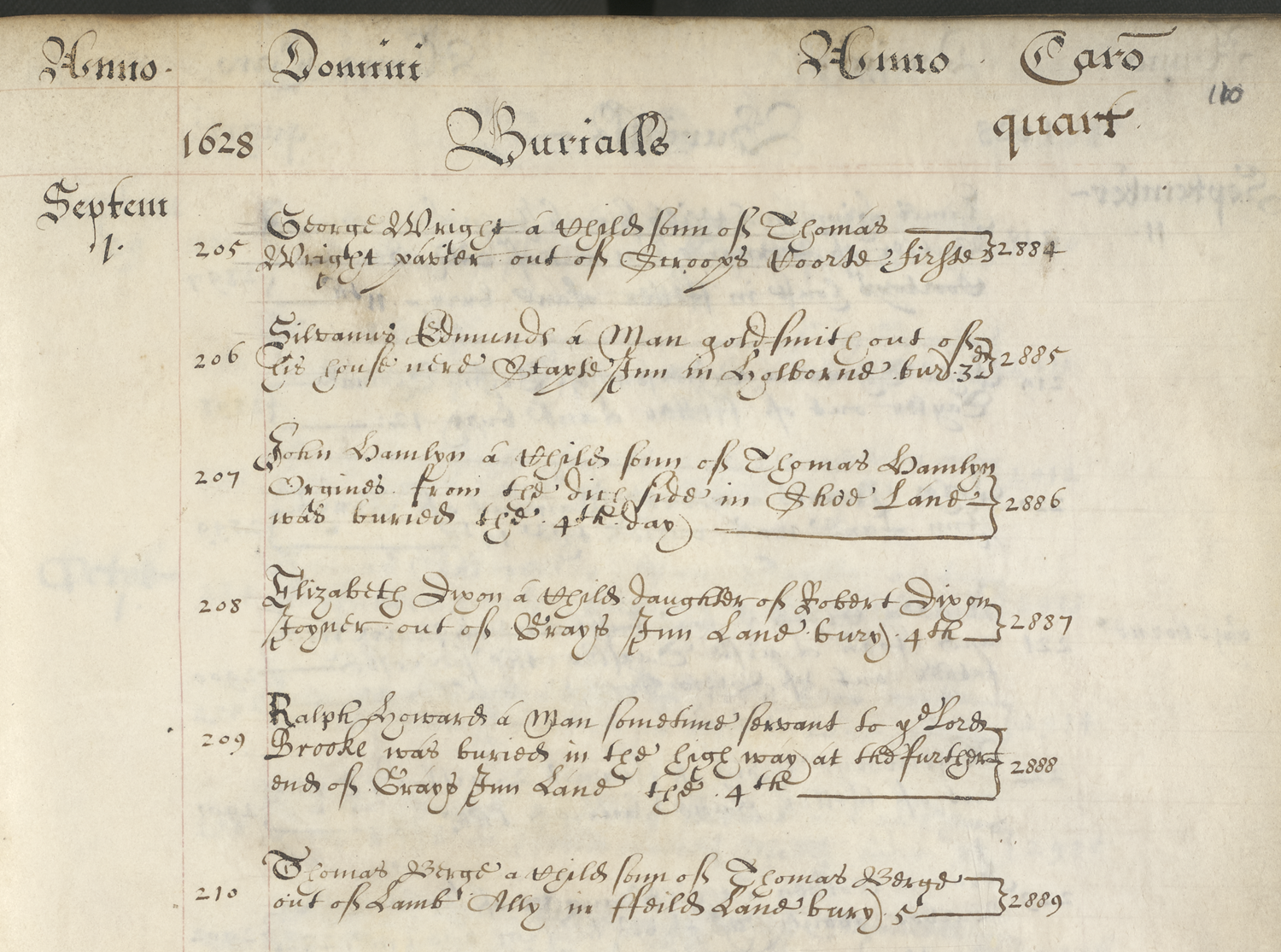
![Ralph Hawarde a man sometime servant to ye the Lord Brooke buried in the highway at the further end of Grays Inn Lane the 4th [September 1628]. | Image held at the London Archives, reproduced by permission of St Andrew Holborn Church Foundation & Associated Charities](https://d23iiv8m8qvdxi.cloudfront.net/wp-content/uploads/2026/03/The_London_Archives_P82-WIDE-CROP-885x658.png "Ralph Hawarde a man sometime servant to ye the Lord Brooke buried in the highway at the further end of Grays Inn Lane the 4th [September 1628].")
As we have read, Fulke Greville’s murder was a particularly gruesome affair. So why did he do it? Well, most of the narrative focusses on Hawarde’s dissatisfaction with the terms of his master’s will; he felt he hadn’t been adequately provided for or had even been left out of the will entirely. The latter point in my view is misleading and may be a misunderstanding because he is not named in the will and because he is not in the list of names in the codicil produced by Greville on his death bed. Hawarde was already dead by then of course.
A long time for feelings to stew?
The original will was produced in February 1627, a year and a half before Greville’s death, so quite a long time for feelings to stew. Hawarde is a witness to the agreement, his signature is plain to see. The original will does not name Hawarde specifically; one item refers to all the household servants receiving a whole years wages and drink and lodging for four months. It does also refer to “over and above any other yearly covenant or contract”. We do know that there is another document in the Greville archive being an annuity drawn up in 1625 for an annual sum of £10 on a yearly rent on land in Kineton for the benefit of Ralph Hawarde.
The codicil drawn up on the 6th September by the dying Greville is more explicit regarding his servants’ benefits. Many are named including Thomas Wilson, who discovered the stricken Greville. They receive annuities of either £20 or £10, and one gets a place in Lord Leycester Hospital. Maybe this clarification is prompted by the altercation with Hawarde. Perhaps the intention was to provide him with an additional £20 a year had he still been alive. We don’t know. A £30 pension at the time was perhaps not great but better than what most people could look forward to. Greville’s great friend Philip Sidney had left a servant of long standing £40 a year on his death 42 years earlier, though this was considered generous.
But would you stab yourself to death and face a suicide’s fate, buried in the highway and often pinioned with a stake? Unless there is more to this story.
Little known about Hawarde
We know comparatively little about Hawarde or his relationship with Greville. We know that there were Howards in Alcester, the location of the Greville’s ancestral home Beauchamp Court. We have also discovered a letter in the Arbury Hall archive written to Lady Ann Newdigate in which Hawarde demonstrates a high degree of literacy.1 He mentions running some errands for her in London, a recommendation from his bedfellow regarding a servant (it was common for servants to share beds, or even sometimes with their master). He also mentions his master and says he ”will remember your service to his house”. The signature matches that on the will and annuity.
So he appears to be a trusted and high ranking servant. We do not know for how long ,though John Aubrey’s Brief Lives written later in the 17th century refers to him as someone “who had long waited on” Greville.
Should not be prosecuted
One interesting aspect of the account of Greville’s murder is that he allegedly asked that Hawarde should not be prosecuted, “that not any man should lose his life for him”. Those that have speculated about Greville’s sexuality point to this, suggesting that there were maybe aspects to his relationship with Hawarde he wished to be kept secret – this may also explain Hawarde’s anguish. For me this doesn’t feel like a premeditated crime but rather an argument in the moment – a boiling over of passions – resentment and frustration with a handy weapon to hand. It is of course something we will never know for sure.
References
1 Warwickshire County Record Office reference CR136/B213A
Extracts from letter written to John Coke, principal secretary to the King by Edward Reed, a servant to Fulke Greville on 1st September 1628. Add MS 64897, Coke Papers, British Library
The Life of Fulke Greville: First Lord Brooke. Ronald A.Rebholz
Fulke Greville, Lord Brooke, 1554-1628. Joan Rees
Sir Philip Sidney, Courtier Poet. Katherine Duncan-Jones
Sleepless Souls, Suicide in Early Modern England. Michael MacDonald & Terence R.Murphy





Comments
Add a comment about this page