
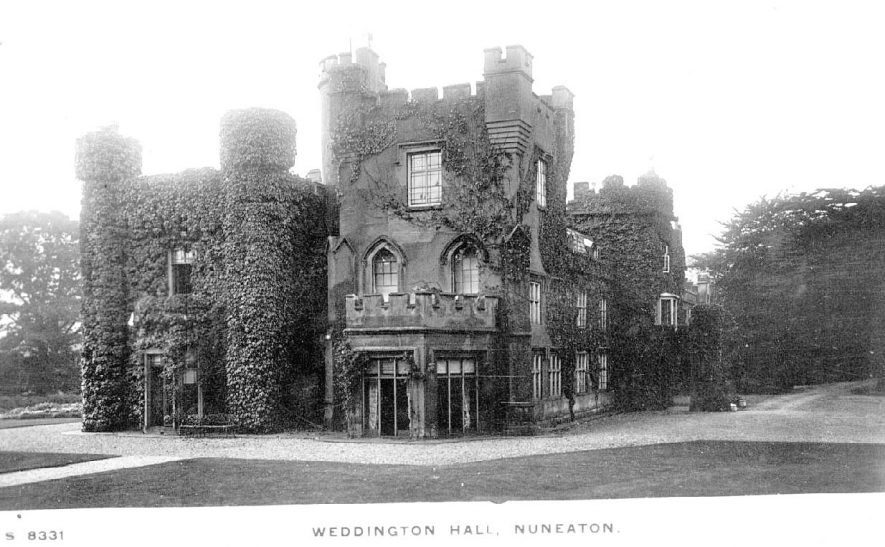
The First War World was to have its own, unique, impact upon Weddington Castle. Changes had already occurred a few years earlier, when, on the 3rd of August 1911 Henry Cunliffe Shawe died, leaving the estate to his son, Henry Nigel Pole Shawe, who went to live in the Grove in 1912.
Edward Melly
In March 1916 one Edward Melly (seen on the far right of the picture to the left) secured the lease of Weddington Hall in order to establish a Red Cross Hospital for wounded soldiers in the building. He paid for much of the equipment needed to make the hospital operational, this on top of several other contributions he and his wife had already made to the war effort. Rooms on the first floor were converted into hospital wards and named after local industrial companies who contributed to their upkeep: “Griff”, “Arley”, “Hall and Phillips”, “Birch Coppice”, “Haunchwood” and “Stanleys” were names painted onto the doors of each ward.
’55 beds’
Weddington Hall Hospital opened its doors to patients in July 1916 with 55 beds. The only trained nurse was Sister Carrington who had come from Burton-upon-Trent. The Commandant was Mrs Fowler, the widow of Colonel Herbert Fowler (a former Director of Arley Colliery) who died early on in the war. There were two Medical Officers, Dr Wolfendale and Dr Edward Nason. The bulk of the staff were 95 V.A.D. (Voluntary Aid Detachment) nurses from the Nuneaton and Hartshill detachment of the Red Cross. In 1916 there were 42 patients. However, by 1918 there were 364 in-patients whose average stay was 48 days, and 60 out-patients each attending on an average of 10 times. Weddington Hall was for NCOs (non-commissioned officers) and Privates. “Many of the patients used to congregate by the drive gateway to chat with Sunday afternoon strollers”.1
‘Injuries included…shrapnel…frostbite and trench foot’
From the register it is possible to work out, for Weddington Hall, that patients stayed for a range of 11–79 days. Their injuries included those from shrapnel, compound fracture of the pelvis, frostbite and trench foot. Some of the soldiers had only been in the Army for a month before being injured. At the end of the war Weddington Hall Hospital was closed and its equipment and linen were donated to Nuneaton’s General hospital.2
Mr Melly had a lifelong concern with hospitals, possibly linked to his father’s cousin William Rathbone, who founded district nursing. He was involved in the creation of the Cottage Hospital in Manor Court Road, making donations and acting as Financial Secretary. He also paid for much of the Weddington hospital equipment – largely through his managership of the nearby Griff Colliery.
This development was also linked to the Castle’s direct ownership; for Mrs Shawe was Vice-President of the Nuneaton Branch of the Red Cross, and the Reverend Bracebridge Hall was Volunteer Aid Detachment Commandant. Sadly, and ironically, Mr Melly died aged 83, along with his wife, in the World War II Nuneaton Blitz of 17th May 1941 which obliterated their Church Street home.
The beginning of the end?
Aside from the war, in 1916 a stained glass window dedicated to Henry Cunliffe Shawe was placed in St. James’ Church. The following year marked the beginning of the end of the Weddington Castle and Estate, with H.N.P. Shawe starting to sell off the Castle’s surrounding lands and farms. In 1917 he sold Lower Farm (acreage: 87a 2r 22p) to Charles Mills, a farmer from Leicestershire for £2,850. A year later, the Great War over, the Red Cross withdrew from the Castle.
This is an abridged version of an article that appeared on the Weddington Castle website [dead link] and is reproduced with their permission.
References
1 Quote from Mr C E Young (correspondent from Tasmania, Australia) in a letter to Nuneaton Evening Tribune 22/04/87
2 Detail above on Weddington Hall as a Red Cross Hospital adapted from “Nuneaton Hospitals: The First Hundred Years” by Jennifer Burton and John Bland.





Comments
Add a comment about this page