
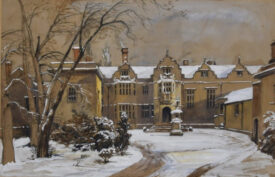
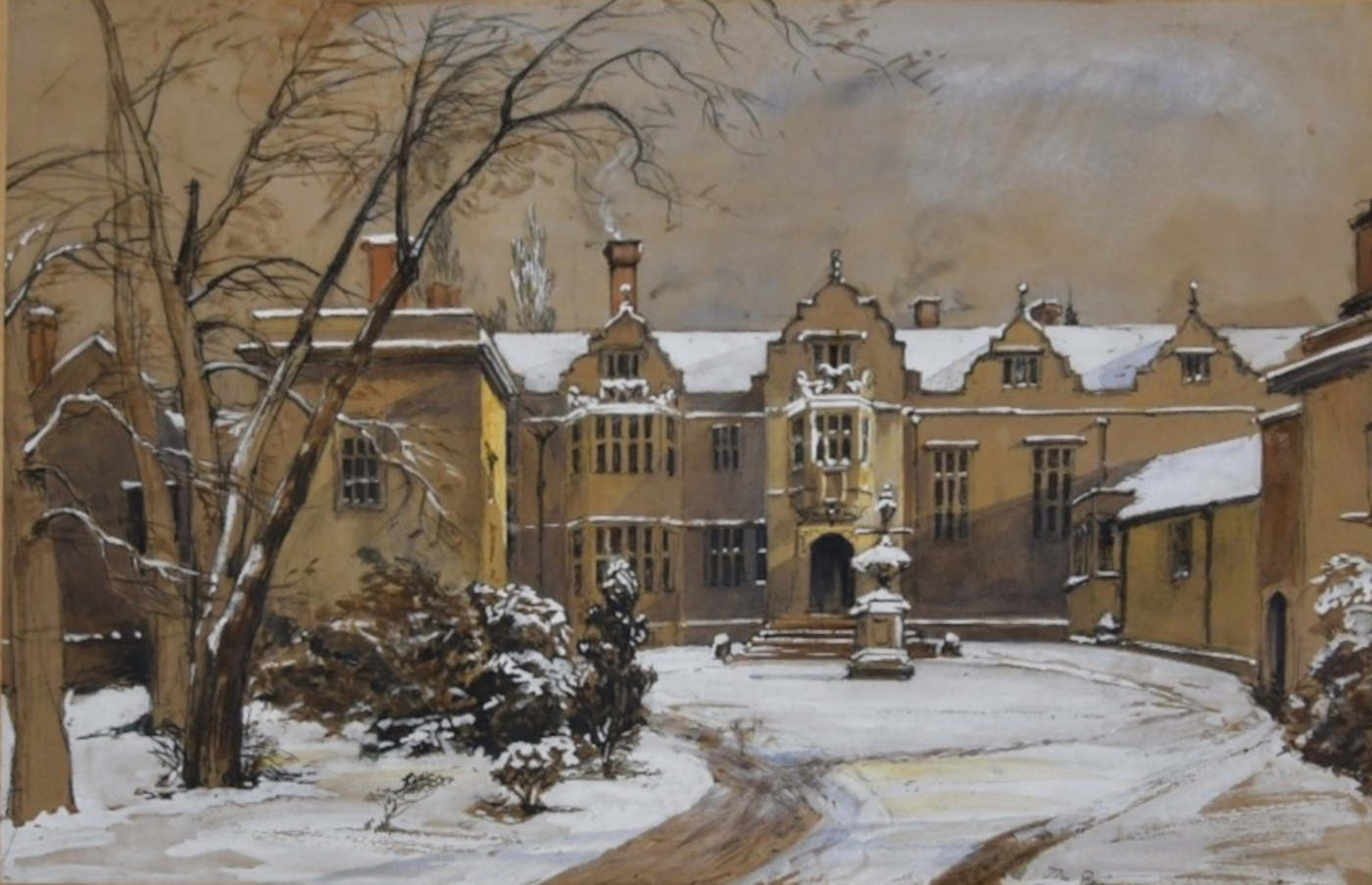
“Every picture tells a story” so the saying goes. The above picture appears to have many tales to tell, including who may have been the artist
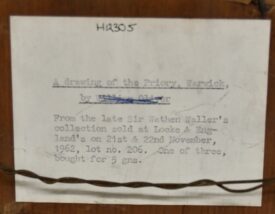
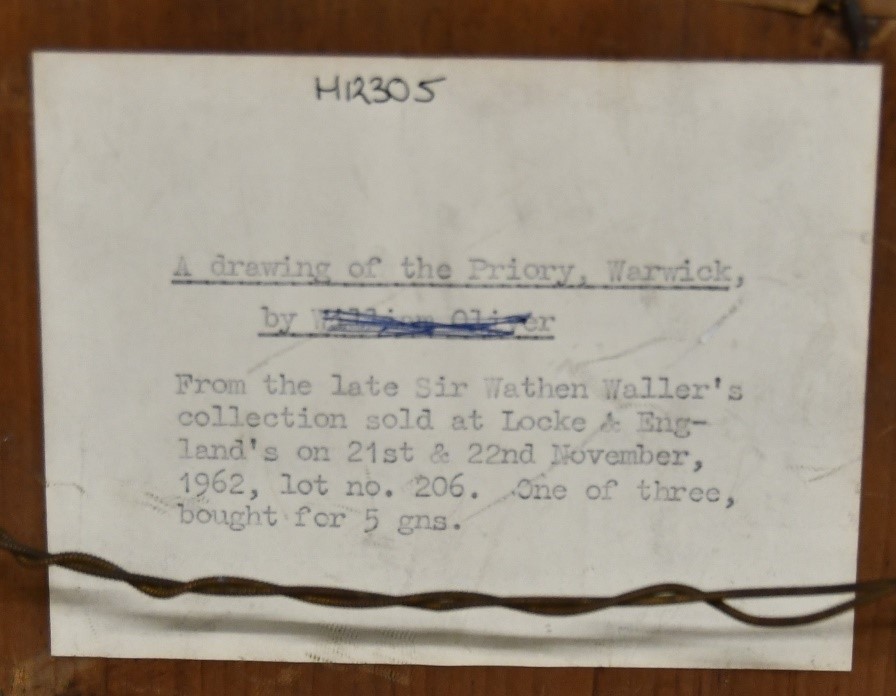
Whilst seeking out objects for Christmas Social Media posts, I came across this drawing of the forecourt of the ‘Priory Warwick’ worked in crayon and watercolour. It was completed in January 1842, according to the handwritten date on the front, and acquired by the museum in 1962. The building was in Priory Park, Warwick where the County Record Office is situated today. Whilst it’s a lovely painting it’s the stories from the information on the reverse which are interesting and the many questions they raise.
There are many links to the Priory and Warwick Museum. Several objects have come into the collection over the years from the Priory and its grounds, and there have been various links between owners or occupiers of the Priory and the museum.
The possible artist – contenders
One of the most interesting stories to be told from this painting focuses on its possible artist and original owner, Miss Louisa Anne Ryland (1814-.1889). She lived with her family at the Priory as a young child from 1835. By the age of 29 she had lost both her parents and was a wealthy heiress, owning land in Ladywood, Sparkhill, Small Heath, Northfield and Mosely, from which she gave 66 acres of land to be used as a park, (Cannon Hill) in 1873.
After leaving the Priory, Louisa lived in Barford Hill House, just outside of Warwick, where she provided a coffee shop and reading room for the locals. Nearby in Sherbourne she used her position in society to have its pub closed down, but provided the money to build the parish church. You can see her views of how life ought to be lived reflected in these acts. Louisa never married, so on her death left all her wealth to over 100 heirs and numerous institutions.
Louisa had a keen interest in art. During her lifetime, she was the main donor to the Birmingham Government School of Ornamental Art, now known as Birmingham Institute of Art and Design. Today, students can still apply for scholarships from a fund she set up in 1876. The family name also lives on in Warwickshire. Where her home once stood in Barford, we find Ryland Road.
Another contender as artist for this picture is William Oliver (1804-1853). His name appears on the typed label on the back of the painting but has been crossed through. There is another picture of the Priory in existence, originally painted by William Oliver and lithographed by his wife Emma Oliver, which suggests that a previous museum curator had suspected a link between Oliver and our painting. Why was Oliver suggested and then dismissed, and by whom? We may never know.
Where did the painting come from?
So we are not able to give a conclusive answer to who the artist was. However, we do know where we acquired it.
On the back of the drawing the label records that it came from the late Sir Wathen Waller’s collection which was sold by Warwickshire auctioneers Locke and England in November 1962. Our records then state ‘Bought afterwards from Percy Wales’ which was a furniture/ antique dealers shop on Regent Street in Leamington Spa from 1950 until 2019.
Who was Sir Wathen Waller (1881-1947). He was a member of another wealthy and influential family also connected to the Priory. His grandmother was Catherine Wise before her marriage, and the Wise family owned and lived at the Priory. It was the Wise family who subsequently leased the Priory to the Rylands. Sir Wathen himself didn’t live at the Priory, but inherited the properties known as ‘Woodcote’ and ‘The Rock’, both at Leek Wootton, just north of Warwick. He and his wife lived at The Rock during World War Two. He died shortly after the war, so presumably it was on his wife’s death that the picture was auctioned off.
The final question, which unfortunately at the time of writing is still unanswered, must be how did Sir Wathen come to have this picture in his possession? Maybe one day the truth will be discovered.
This has been a fascinating painting to research and it has increased our knowledge greatly of those who came before and contributed to the development of our county and its culture. But many questions still remain. Hopefully at a future point as time allows, more of its stories will be uncovered.
References
The Wise and Waller Families at Woodcote – Early Years – Our Warwickshire
The Wise and Waller Families at Woodcote – Later Years – Our Warwickshire
Warwick Priory – Our Warwickshire
Louisa Anne Ryland | People | Barford Heritage
PERCY WHALE FURNITURE LIMITED overview – Find and update company information – GOV.UK
Art students on road to success | Birmingham City University





Comments
Add a comment about this page