
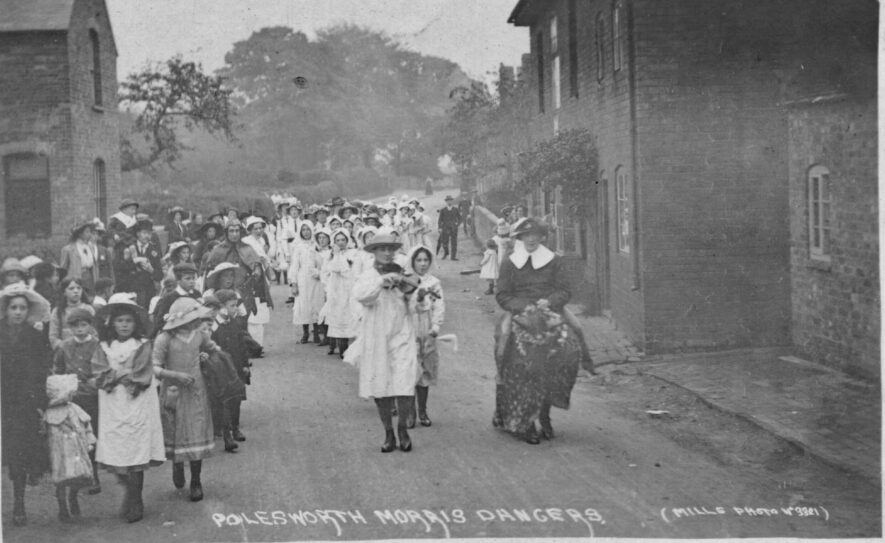
On 6th & 7th of July 1910, at an “Olde English Faire” in the North Warwickshire mining village of Polesworth, a troupe of Morris dancers performed for the first time. Consisting of adults and children from Polesworth and Dordon, the troupe had been created by Mrs G.M.Fowler of Hall End Hall; her husband was a wealthy mining engineer, and she was the daughter of the Vicar of Polesworth, Canon Trotter. The troupe was taught Morris by Florence Warren from the Espérance Club in London which was founded by Mary Neal, whose mission was to restore traditional English dance and music “to the people.” The Club was teaching Morris all over England, and middle-class enthusiasts like Mrs Fowler frequently acted as the catalyst for the creation of Morris troupes in their home villages.
The Jester Headmaster
The troupe performed Morris dances, songs and children’s games. The personnel included Mr Tom Starmer, head of the school, who was the Jester, several elementary school teachers, younger men from the mining industry, mainly single women, and boys and girls. There were two fiddle players for music on separate occasions, a pianist and a Hobby Horse.
During 1910 – 1912, a number of performances at local events like Polesworth Wakes were reported in the press, and there may have been others. However, the biggest event was the Tamworth Millenary celebration in July 1913, when the Polesworth troupe were booked to perform on the two successive days of the celebration, with two extensive programmes of Morris Dances, Country Dances, Songs and Children’s Games each day. The Tamworth Herald listed all those who performed as they were awarded the Millenary Medal, so we have their names. The total number was about 90 men, women and children. On this occasion the troupe was paid £8 5s 4d for “brake hire and dance fee”, and the published accounts include payments for tea each day for the Morris Dancers, presumably between the two performances, and because there were children.
Country dances
At Tamworth, Mrs Fowler had begun to expand the troupe’s repertoire beyond what had been taught by Florence Warren, and this trend continued into the following year, when they appeared again at Tamworth Castle at a fund-raising event for St John’s School, having been booked because of their notable success the previous year. That year Mrs Fowler included a dozen dances from the Playford collection of country dances alongside the Morris, branching out from the narrower definition of the “people’s” tradition favoured by Mary Neal.
A couple of performances are recorded in 1915, connected with the Red Cross, of which Mrs Fowler was an officer. In October 1915 Mr Fowler was killed in action in France, and there are no further reports of the troupe performing. In 1916 Mrs Fowler became Commandant of the Red Cross Hospital at Weddington Castle near Nuneaton, and after the war moved to Leamington Spa, where she established herself as a notable local figure, but she had left the Morris behind.





Comments
Add a comment about this page