
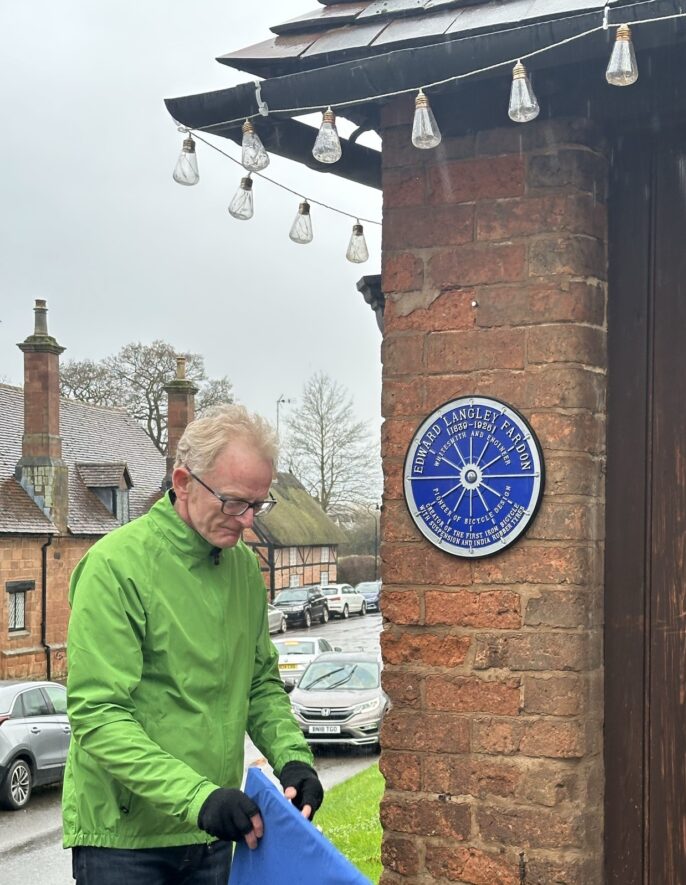
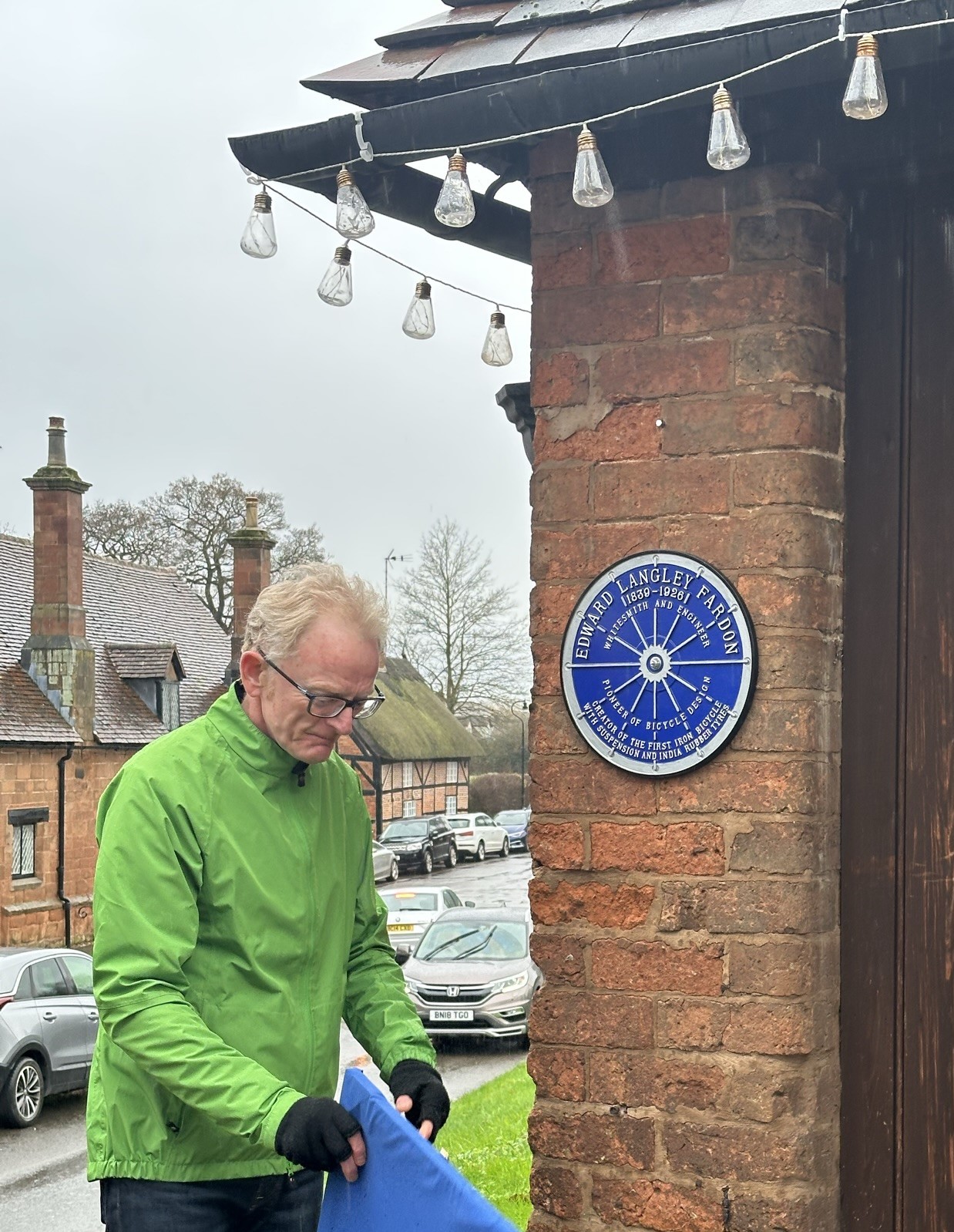
On a cold and wintry December morning at the tail-end of “Storm Darragh”, more than 30 brave souls gathered at The Forge in the centre of Stoneleigh village to witness the unveiling of a blue plaque to Edward Langley Fardon. But who was Fardon, and why was he important?
He was born in Leamington on December 11th 1839 and worked for many years as a blacksmith and engineer in both Kenilworth and Stoneleigh. The Fardon family had been blacksmiths for generations when Edward took over his late father’s business in Castle End, Kenilworth some time after 1865. Young Edward had learnt the trade in ornamental ironwork by working for the renowned Francis Skidmore of Coventry, whose artistic metalwork includes the Albert Memorial and screens in Hereford and Lichfield Cathedrals. Edward subsequently worked for, among others, the Rothschilds, in both Switzerland and France, and it is hardly surprising that he was asked to move to Stoneleigh by Lord Leigh, who commissioned elaborate metal gates for the abbey. For nearly 50 years he played an active part in the life of the village.
Renting the forge
Lord Leigh’s notebooks reveal that Fardon was renting the forge in the centre of the village by 1872, and had moved into his newly-built house in Church Lane, Stoneleigh, in 1874. By the time of the 1881 census he is described as a master blacksmith, and as years went by, his occupation was variously given as whitesmith, ironworker and engineer.
Fardon’s “claim to fame”, however, lies in his contribution to the development of the modern bicycle. His “velocipede” design – held today by his family – is dated and inscribed “Stoneleigh 1869” , which suggests that although he still had premises in Kenilworth, it was here that he worked on his improvements.
Newspapers of the day state
Mr Fardon is said to have made the original suspension wheel, and the first entirely iron cycle which was provided with an india-rubber tyre.. He began the construction of the machine towards the end of 1868, and it was finished early in the following year…the front wheel was 42 inches and the back 18 inches. Mr Fardon had never seen one with more than a 36 inch wheel. At that time wooden, but not iron, bicycles were being made in Coventry. The rim of the cycle was very interesting. First there was a T rim, outside which was fastened another rim, dovetailed shape, wider at the top than at the bottom. It was into this that he fitted a solid rubber tyre…One ingenious device which Mr Fardon introduced was that for the lubrication of the front hub…the hub was a solid piece and its extremities revolved in the front forks. To ensure lubrication he inserted a small portion of sponge saturated in oil. This was constantly rubbing on the face of the metal and added materially to the ease of running.
In the history of the bicycle industry much credit is given to James Kemp Starley of Coventry, whose statue stands on Greyfriars Green. Fardon was a modest man, however, and did not patent his designs. In another newspaper we read:
Unfortunately Mr Fardon did not patent these improvements and therefore derived no benefit from his originality… [and] it is to his genius we owe one of the greatest improvements in the modern bicycle, namely, the spider wheel, although it is generally attributed to a Coventry man…
Family in the village
Legend has it that he spoke about his inventions to an employee at Stoneleigh Abbey, who then told Starley. Edward Langley Fardon continued to live in Stoneleigh until his death at the age of 83 in 1926 – he had been an active participant in the life of the village for half a century. He and some of his immediate family are buried in the churchyard, and it is only very recently that his descendants – who also played a huge part in village life – have moved away. Kenilworth can also boast a strong connection with this important inventor and engineer, and we are hopeful of collaborative commemorations when the centenary of the great man’s death occurs in February 2026.





Comments
There are errors in this account and on the Blue Plaque. Fardon’s machine did not have suspension, but it also omits perhaps the greatest innovation in the use of spokes in tension for his wheels for the first time. The existing drawings are not originals but more modern copies made by his grandson. The suggestion that Fardon worked on his ‘improvements’ in Stoneleigh is incorrect; there is no doubt that the machine was constructed in Kenilworth and that his first rides upon it were there too. A full account can be found in my book “Kenilworth People & Places Volume 1”
Add a comment about this page