
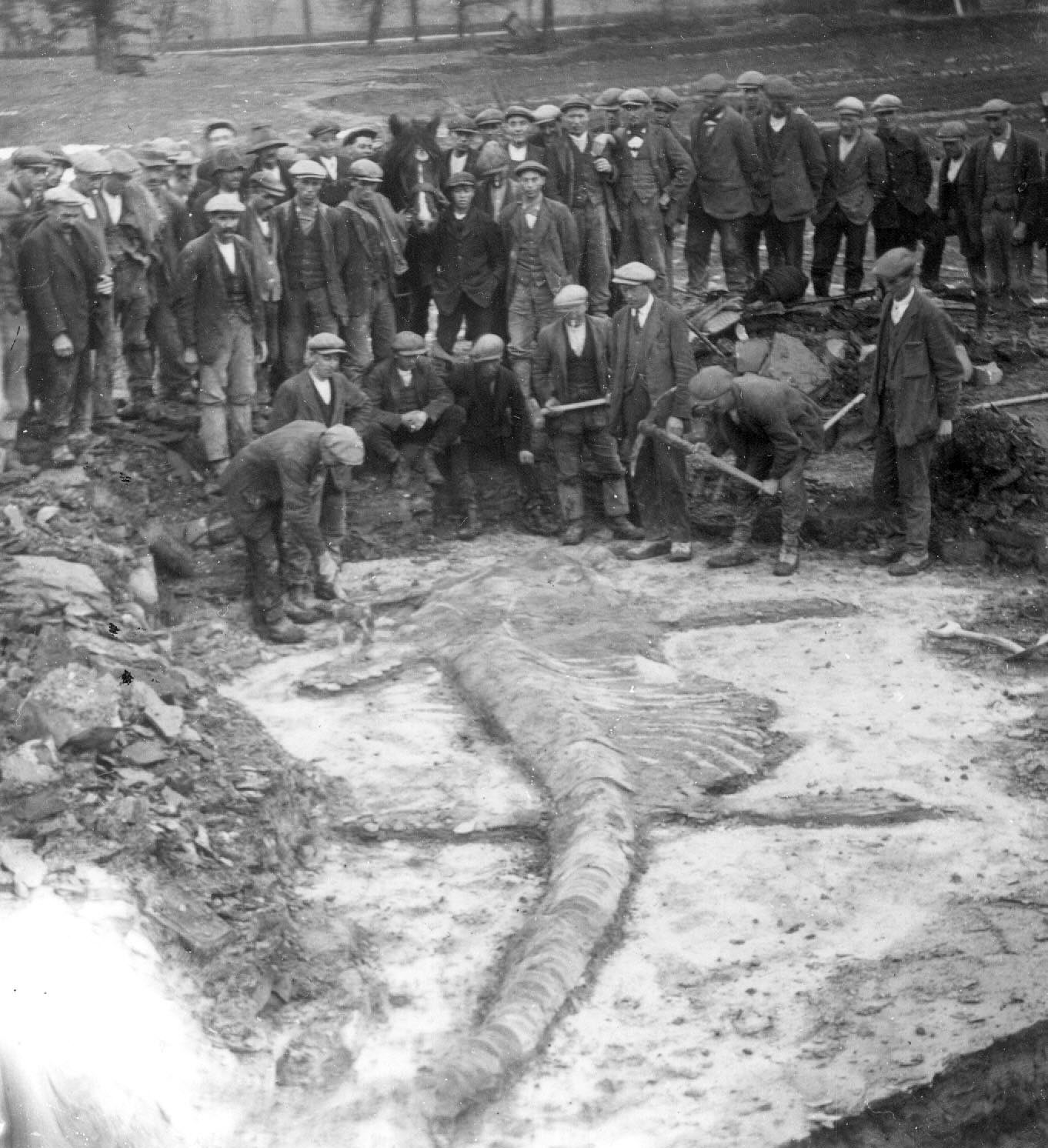
![Harbury quarry showing fossil of Ichthyosaur discovered there. 1928[Specimen now in the Natural History Museum, London. A similar one can be seen at the Warwickshire Museum, Market Hall, Warwick].[The quarry manager, Albert Hodges, is in the front row, third from the right, with a tie. He died in 1953] | IMAGE LOCATION: (Warwickshire Museums. Photographic Collections.)](https://d23iiv8m8qvdxi.cloudfront.net/wp-content/uploads/2016/11/7291-0-808x885.jpg "Harbury. Quarry, Ichthyosaur fossil")
Even into the 20th century, quarrying was carried out by manual labourers using hammers and pickaxes. The quarry workers who came across important fossil specimens often remain nameless. At the time, their contributions were often seen as insignificant and therefore, we often do not have a record of who was involved. We do not know who they are.
This image of the ichthyosaur fossil tells an important story. It demonstrates that many people were involved in the fossil’s discovery at Messrs Greaves, Bull and Lakin’s quarry in Harbury in 1928. In the front row of the photo, we have Albert Hodges who was the quarry manager. He stands at the front, third from the right, in a collar and tie. However, we do not know who the other workers are.
A gender gap
What do we know about the quarry workers if we do not know who they were? We can see from the image that they were all men and of various ages. Interestingly, there are no women. We know that women were actively involved in archaeology during the early 20th century as there are famous figures including Maud Cunnington and Tessa Verney Wheeler1. Women’s contributions to the field were often undervalued or attributed to male colleagues.
Hard to identify
Unfortunately, the Tamworth Herald newspaper report of this amazing discovery has been of little help in identifying those who did the hard work of excavating the ichthyosaur fossil. It only notes Mr Swinton who visited the quarry from the Natural History Museum.
Today, as part of the Unlocking Collections project, we celebrate all who worked with Albert Hodges and made this discovery. We recognise the work of all labourers involved in the discovery of geological specimens throughout history.
References
1 Six Groundbreaking Female Archaeologists | English Heritage





Comments
Add a comment about this page