

At a committee meeting held on Friday 23rd February 1940 at Kenneth Rayner’s house, the question of running the club during wartime was discussed at length. It was decided to circulate all members pointing out that the matter would rest with the amount of support that could be relied upon. A further meeting would be arranged to assess members’ responses. On Tuesday 12th March the replies to the circular were considered. Nearly £180 had been promised in subscriptions and, after reviewing possible expenditure, the decision was taken to continue to play cricket, although in a “modified” form.
A lack of reference
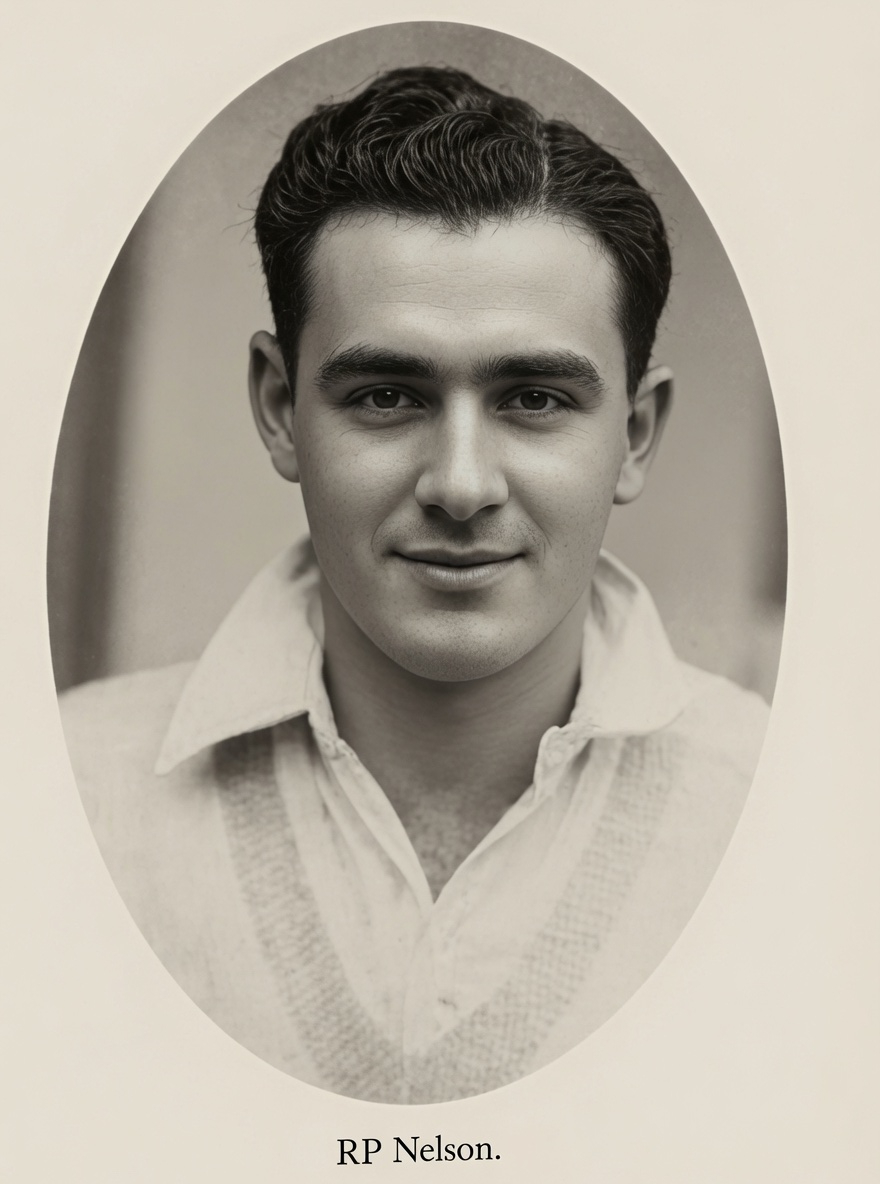
In contrast to the praises elicited by the club for those who volunteered in the First World War, there is no reference in the 1939-1945 minutes to any aspect of club members’ personal involvement in the Second World War – nothing at all similar to FA Ward’s eulogy to SS Forsyth. Strikingly, CG Toppin’s award of the MC in 1940 is unrecorded. Neither, remarkably, was the death of Robert Prynne Nelson; aged 28, he was killed in October 1940. A Cambridge Blue in 1936, he went on to captain Northamptonshire. Nelson had played for Leamington CC on occasion in 1939.
Even more astonishing is the omission in the Minutes of the death on 13th August 1940 of PT Eckersley (b.1904); educated at Rugby School and Cambridge, he became Captain of Lancashire CCC, aged 24, in 1928 and held that role until 1935, winning the championship in 1934. In 1935 Eckersley was elected a Manchester MP. Known as the ‘cricketing-airman’ he volunteered for the Fleet Air Arm (RNVR) but was shot down and killed in August 1940. From 1932 he brought hugely talented teams to play Leamington CC. It is difficult to understand the absence of any reference to this man.
Drunken aircraft workers and a “mad tyranny”
1941 saw much made of the Warwickshire Land Army, the continued coal and water shortages and rampant food profiteering, while the Golf Club had part of its acreage turned over for agricultural purposes. There was some publicity about drunken aircraft workers but even more on the Chief Constable’s disciplinary methods (described as a “mad tyranny”) as well as Warwick School Headmaster’s “negligence” when one of his pupils lost an eye while working in a farmer’s field. On the positive side, Lockheed Sports and Social Club donated two ambulances to the Red Cross and in egg week, 10,685 eggs were collected for Warneford Hospital.
The club, however, successfully came through the war period, winning 107, drawing 61 and losing only 55 of its games. Of note was the coming to notice of MG Barker, a Warwickshire policeman. Why he was omitted from the Leamington averages is a mystery, especially as in one match for Leamington he made 102 not out and took 5 for 46. A week later, playing for a District XI he scored 132 not out against Leamington. After the war, Barker made his county debut in 1946 against Sussex but only played four more matches that year, although he did take 7 for 68 against Yorkshire. However he continued to feature prominently in local cricket.
Prospects of a good season
By 1945, at the AGM on 7th April, it was reported that “despite the war the club remained in a flourishing position although a great deal of money would have to be spent on the restoration of many amenities and the carrying out of long overdue imrovements.” Membership was reported at 192 and ground collections had increased from £44 to £48 18s. HJB wrote “the ground is looking exceptionally well, very trim and businesslike… the prospects of a good season appear to be quite bright and hopeful.”
The Honorary Secretary, JHT Langley, mentioned in the AGM “complaints he had received from many members of children running wild around the Pavilion enclosure, thereby creating a nuisance by reason of the noise they made.” During a discussion on this matter it was pointed out “that the children of visiting teams were always the worst offenders.” The press were invited “to ventilate the matter in their report.” There was no comment!
This is a modified and abridged version of text from Mark Ryan’s Cricket in Leamington and Leamington Cricket Club. Highly praised by Wisden, the book can be purchased here.





Comments
Add a comment about this page