
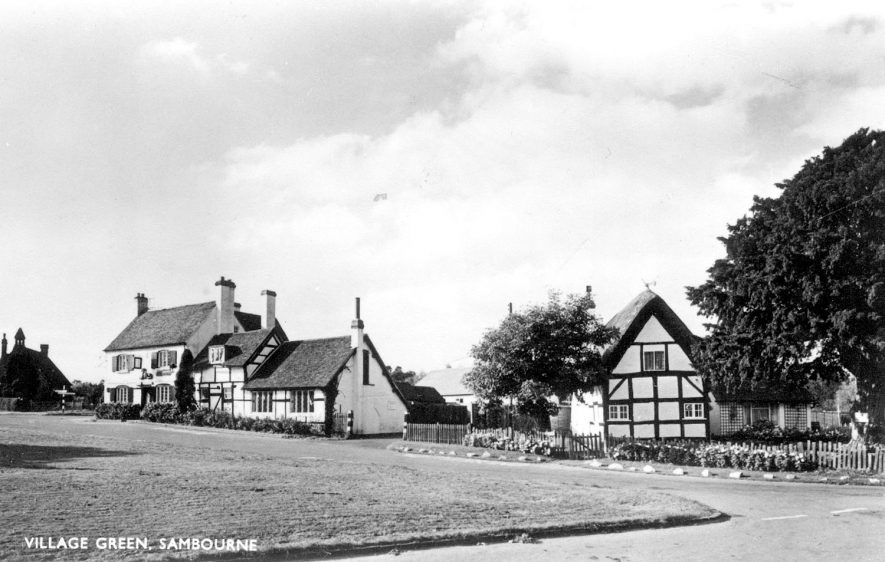
I was born in Sambourne Lane in 1952. My paternal grandfather was William Parsons whom I believe was born in what is now Jill Lane in Sambourne. The house was demolished when a small spring or fishing tackle factory was built which has also been demolished and replaced by residential properties. Will Parsons is reputed to have had a fine tenor voice and was something of a local entertainer. On marriage he moved a mile up the road to Astwood Bank in Worcestershire, where they lived in Forgate Street.
Spanish Flu
My grandfather was a master baker and worked in Redditch and my father was the second child of the family born in 1912 – his sister Dorothy was the oldest child and his brother George was three years younger than my father. Will Parsons was apparently deemed unfit for military service in World War One as a result of flat feet, However, sadly the war and its consequences did not pass him by as he became a victim of the Spanish flu and died. My father told me this story when he was in his 70s and I could still hear the hurt in his voice. I don’t know the date of my grandfather’s death but my father was six years old, and to use his words:
He was laid to rest on Armistice day and I couldn’t understand it because everyone was celebrating.
Buried alive twice
Subsequently his mother remarried and there was a half sister Joyce, though this was not a happy period for my father. The step father (whose name I do not know) had suffered badly during World War One. I am told he was buried alive twice and dug out and left with very poor health as a result of a gas attack. He died at the end of World War Two. He was, or became, an alcoholic as a result of which my father remained tea total for life and the family lived through very difficult years.
At the age of 14 my father entered work in the coil spring trade, into which he was followed by his brother a few years later. I know that my father had a period of unemployment in the early 1930s and worked near Birmingham for a time. He lived in digs for a while but then bought a bicycle on weekly payments and cycled the miles to and from Birmingham. He said the first time he cycled down the Evesham Rd. in Astwood Bank “he felt like a king” and he remained a cyclist throughout his life – in the years before and immediately after the war he cycled to Aberystwyth with his brother and friends for their annual camping holiday. Before the war and throughout the war years both my father and his brother worked at Heath’s Springs in Webheath, a district of Redditch.
Met sheltering under a hedge
My father was a springmaker and his brother a tool maker in the coil spring trade, and both were designated as being in reserved occupations so they remained in place throughout the war. My father was also an ARP warden and witnessed the glow in the sky on the night of the “Coventry Blitz”. My Uncle George always maintained that during the war years Heaths made springs for the detonation mechanism for Barnes Wallis bouncing bomb and that he saw blueprints of the device but how verifiable this is is somewhat uncertain. It was on VE day that my father and mother met sheltering under a hedge from a heavy rainstorm on their way to work and married in April 1946.






Comments
Add a comment about this page